
VAYORA · Raw Material & Quality · B2B Buyer Education
Chinese Hair vs Indian Hair vs Vietnamese Hair: A Wholesale Buyer’s Guide
Chinese hair, Indian hair and Vietnamese hair are frequently discussed as if each represents a fixed quality level.
For wholesale wig buyers, this can be misleading.
Country of origin and quality grade are not the same thing.
Each sourcing market contains different donors, collection methods, sorting standards and processing levels.
The correct comparison should therefore focus on both origin and specification.
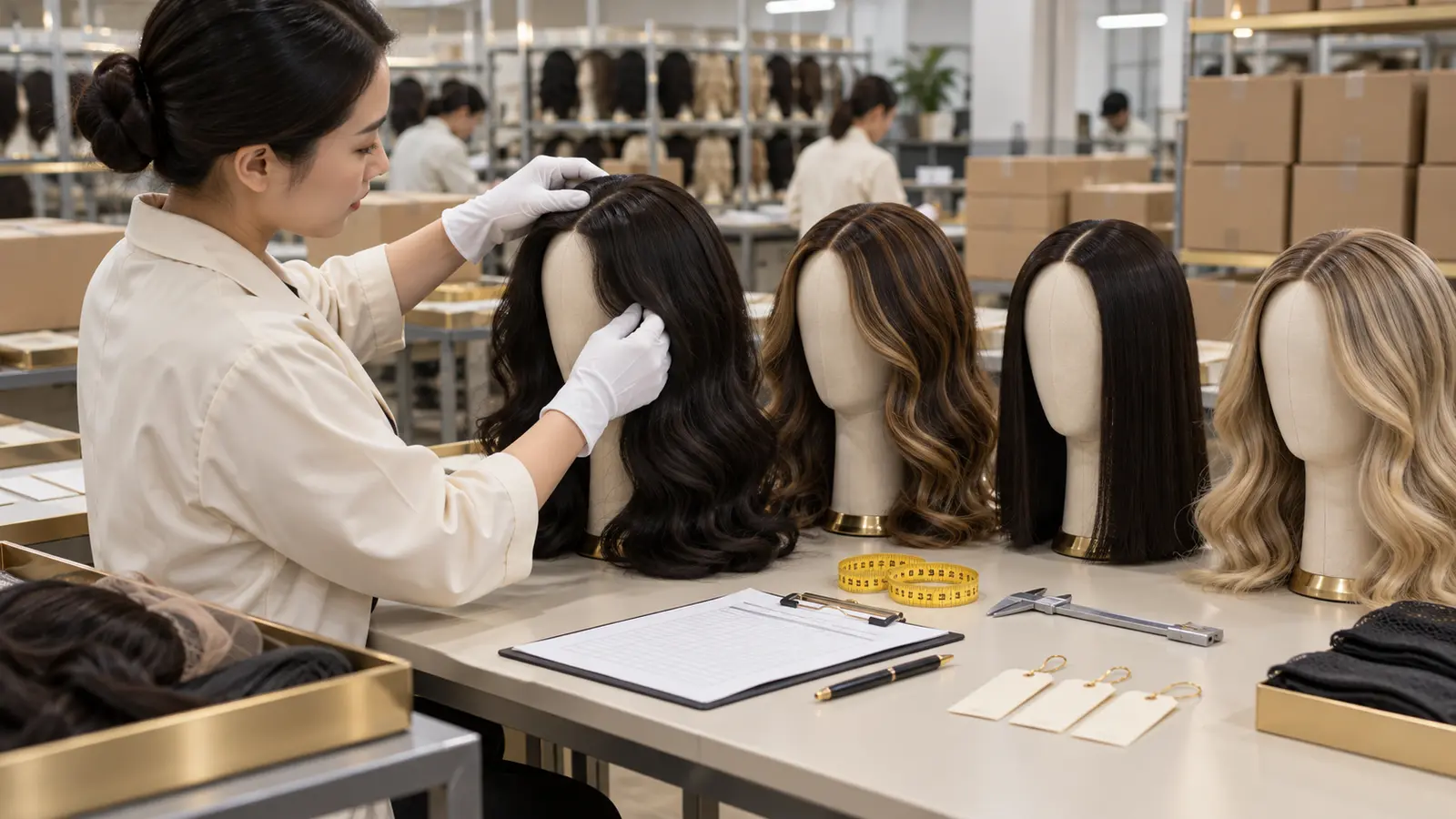
Chinese Human Hair
China has one of the world's most developed human-hair processing and wig-manufacturing supply chains.
Within the premium segment, buyers may encounter Chinese ponytail or braid-collected hair selected for wigs, toppers, men's hair systems and extensions.
Depending on the batch, buyers may value it for characteristics such as:
- relatively consistent strand structure
- good mechanical strength
- suitability for selected premium products
- strong downstream manufacturing capability
However, the label Chinese Hair by itself does not guarantee that the hair is raw, virgin, cuticle-aligned or minimally processed.
Those specifications must be verified separately.
Raw Indian Hair
India has a long-established human-hair collection and export industry.
Raw Indian temple hair is particularly well known in international hair markets.
Premium material may retain its natural cuticle and root-to-tip alignment when it is correctly collected and processed.
Indian hair also has considerable natural variation.
Different donors can produce straight, wavy or curly textures, as well as different strand diameters.
This variation is one reason professional buyers should approve the actual material specification rather than purchasing solely according to an origin label.
Raw Indian hair is commonly used for:
- wigs
- bundles
- closures and frontals
- extensions
- custom-colored products
Vietnamese Human Hair
Vietnamese hair has become increasingly visible in the international wholesale market.
Premium Vietnamese raw hair is commonly marketed as unprocessed hair with intact, aligned cuticles.
Straight and naturally dark hair is particularly common in commercial supply.
Depending on the selected grade and donor material, Vietnamese hair can be suitable for:
- long straight wigs
- bundles
- wefts
- keratin extensions
- closures and frontals
- custom color programs
As with every origin, buyers still need to distinguish genuine raw material from processed hair marketed under an attractive origin name.
Which Hair Is Best for Bleaching?
There is no reliable answer based only on nationality.
Color-lift performance depends heavily on:
- previous chemical exposure
- cuticle condition
- natural pigment
- strand strength
- processing method
- bleaching formula and technique
If blonde shades are commercially important, Vayora recommends testing the actual production batch rather than relying on claims such as:
“Can bleach to #613.”
For professional purchasing, a controlled test gives more useful information than a marketing statement.
Which Hair Is Best for Long Wigs?
For 24–40 inch wigs, origin is again only one factor.
Long-hair buyers should pay particular attention to:
- percentage of full-length strands
- end thickness
- total wig weight
- donor mixing
- tangling after washing
- strand breakage
- texture consistency
- repeat-order availability
This becomes increasingly important above 30 inches because the availability and cost of genuinely long donor hair increase significantly.
What About European Hair?
European and Slavic-origin hair occupy a specialized luxury segment.
Naturally lighter colors and finer textures can make this hair attractive for premium wigs, toppers and specialty markets.
However, genuine high-quality supply is considerably more limited than mainstream Asian hair supply.
For large commercial programs, buyers should therefore evaluate not only initial quality but also whether a supplier can maintain the required material specification over repeated production.
A Better Way to Compare Hair
Professional wholesale buyers can use the following framework:
| Evaluation Point | What to Check |
|---|---|
| Origin | Claimed sourcing region |
| Raw / Processed | Previous chemical or texture processing |
| Cuticle | Intact, damaged or removed |
| Alignment | Root-to-tip direction |
| Drawing | Single, double or custom selection |
| End Fullness | Thickness through the final inches |
| Color Performance | Controlled strand test |
| Wash Performance | Tangling, matting and texture change |
| Construction | Wefting or wig ventilation quality |
| Repeatability | Ability to reproduce approved quality |
Origin Matters. Specification Matters More.
Chinese hair can be excellent.
Indian hair can be excellent.
Vietnamese hair can be excellent.
They can also all perform poorly when the wrong grade or processing method is selected.
For wholesale buyers, the goal should not be finding a country name that sounds premium.
The goal should be finding a repeatable raw-material specification that performs consistently for the intended product.
That is what makes a hair program scalable.
Compare Hair Options for Your Wig Brand
Vayora can develop different human-hair options according to your target quality, length, texture, density, color and budget.
For buyers comparing multiple quality levels, samples can be prepared for side-by-side evaluation before a larger order.
Frequently Asked Questions
Is Chinese, Indian or Vietnamese hair always the best?
No. Country is not a quality grade. Compare the actual material, processing history, cuticle condition, drawing and performance for your product specification.
Can origin alone predict bleaching performance?
No. Prior chemical treatment, cuticle condition, pigment, strand strength and the test method matter. Use a controlled strand test on the actual batch.
What should buyers check on long hair?
Compare the proportion of full-length strands, end fullness, weight distribution, post-wash handling, breakage and repeat availability for the requested length.
Related Commercial & Buyer Resources
Prepare Your Sample & Quotation Brief
Share your target market, product format, material requirements, length, texture, color and construction for sample comparison and specification review.
Request a Quote