
Minimum order quantity is one of the first questions wholesale wig
buyers ask, but a useful MOQ answer requires more than one number. The
minimum can change according to the wig construction, color, length,
customization level, packaging and quantity allocated to each SKU.
For a new brand, salon or distributor, the objective is not simply to
find the lowest MOQ. It is to build an order that can be sampled,
produced, inspected and replenished efficiently without creating too
many slow-moving variations.
This guide explains how wig MOQ works, why customized projects
usually require different thresholds, and how buyers can move from
sample approval to a commercially practical bulk order.
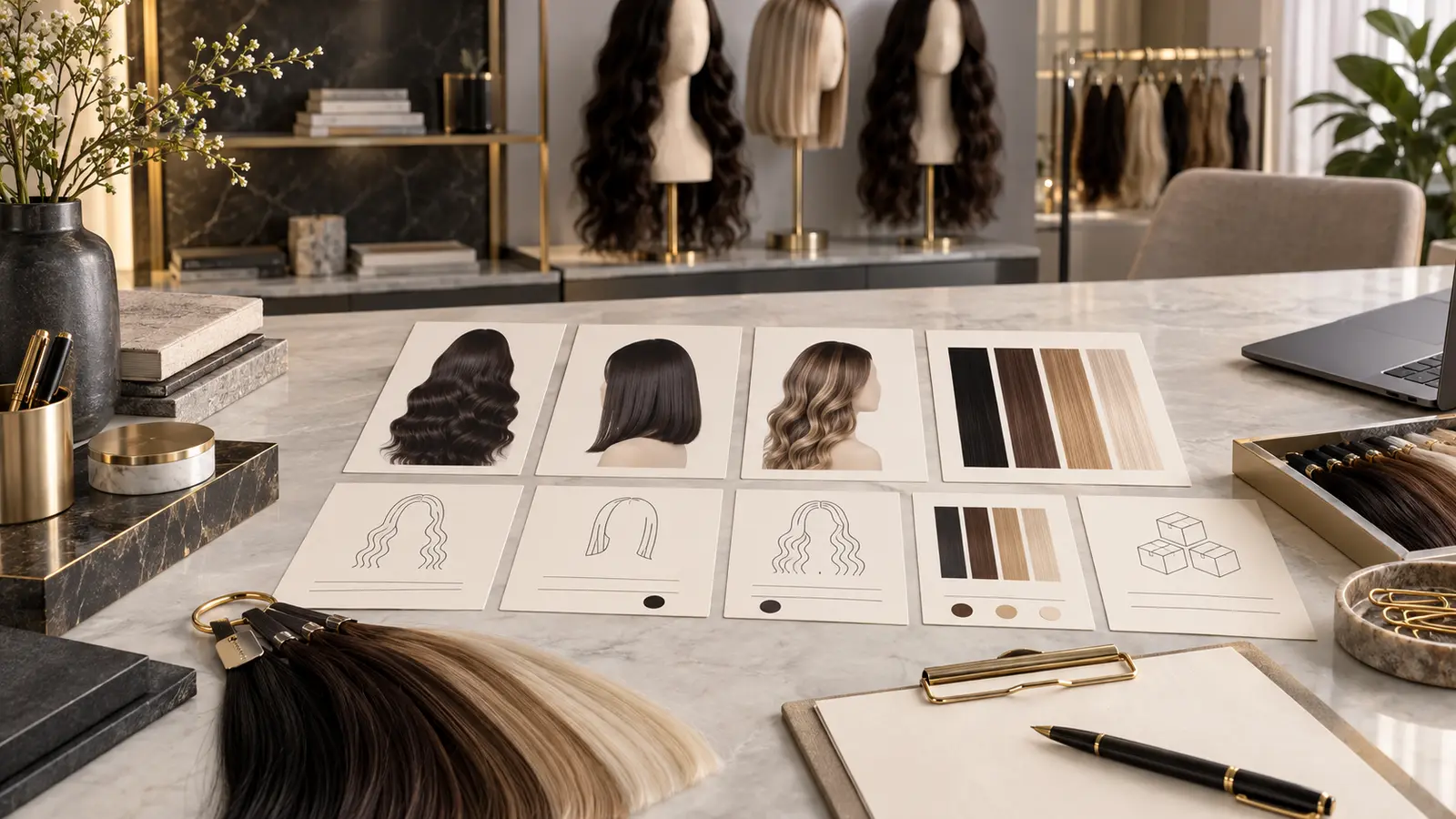
For a practical allocation worksheet after this overview, see the Wholesale Wig MOQ Planning by SKU guide. It helps map proposed constructions, colors, lengths and packaging to the supplier’s project-specific minimum basis.
What Does MOQ Mean in Wig
Sourcing?
MOQ means minimum order quantity: the smallest
quantity a manufacturer can accept for a defined product or production
setup.
The important phrase is “defined product.” A quotation for 100 wigs
may refer to:
- 100 units of one identical style
- 100 units divided across several lengths
- 100 units across different constructions
- 100 units with one shared packaging design
- 100 units with custom colors or other processing
These are not equally complex to produce. Buyers should therefore
confirm whether the MOQ applies to the total order, each style, each
color, each length, each lace construction or each custom component.
Buyer Tip: Always ask “MOQ per what?”—per order, per
style, per color, per length, per packaging design or per custom
specification.
Why Wig MOQ Changes
Product construction
A stock closure wig and a custom ventilated lace design may require
different material preparation and production scheduling. A program
containing 4×4, 5×5, 13×4 and 13×6 constructions also involves more
components than one standardized cap.
Length, density and texture
Longer lengths, higher density and special textures affect material
allocation and production time. Combining too many variations in a small
first order can make each SKU inefficient.
Color requirements
Natural-color programs are often easier to consolidate than orders
divided across several highlights, ombré effects or blonde tones. Custom
color work may require a minimum batch for material preparation and
repeatability.
OEM/ODM customization
Custom cap measurements, bands, combs, labels, logos, inserts and
product specifications add setup steps. The more unique components a
project requires, the more likely that separate MOQs will apply.
Private-label packaging
Boxes, bags, tags, stickers, satin items and printed inserts may each
come from different production processes. The packaging MOQ can
therefore be higher than the wig MOQ. Buyers should ask whether unused
packaging can be stored for future replenishment and under what
conditions.
Learn more about VAYORA’s custom wig packaging
options.
Sample MOQ vs Bulk MOQ
Sample orders and bulk orders serve different purposes.
| Order stage | Main purpose | Typical buyer decision |
|---|---|---|
| Initial reference sample | Check general material and construction direction | Is this supplier and product route suitable? |
| Revised or pre-production sample | Confirm requested corrections and final specification | Is the product ready for bulk approval? |
| Packaging sample | Approve size, print, color and product fit | Is the packaging ready to reproduce? |
| Bulk order | Produce the approved assortment at commercial scale | Are quantities and SKU allocation viable? |
A sample can validate a specification, but it does not automatically
validate every length, color or construction in a large assortment.
Buyers should identify which variations need physical approval and which
can follow an already approved standard.
Use the detailed checks in Wig
Sample Orders: What Buyers Should Test Before Bulk Production before
confirming a bulk order.
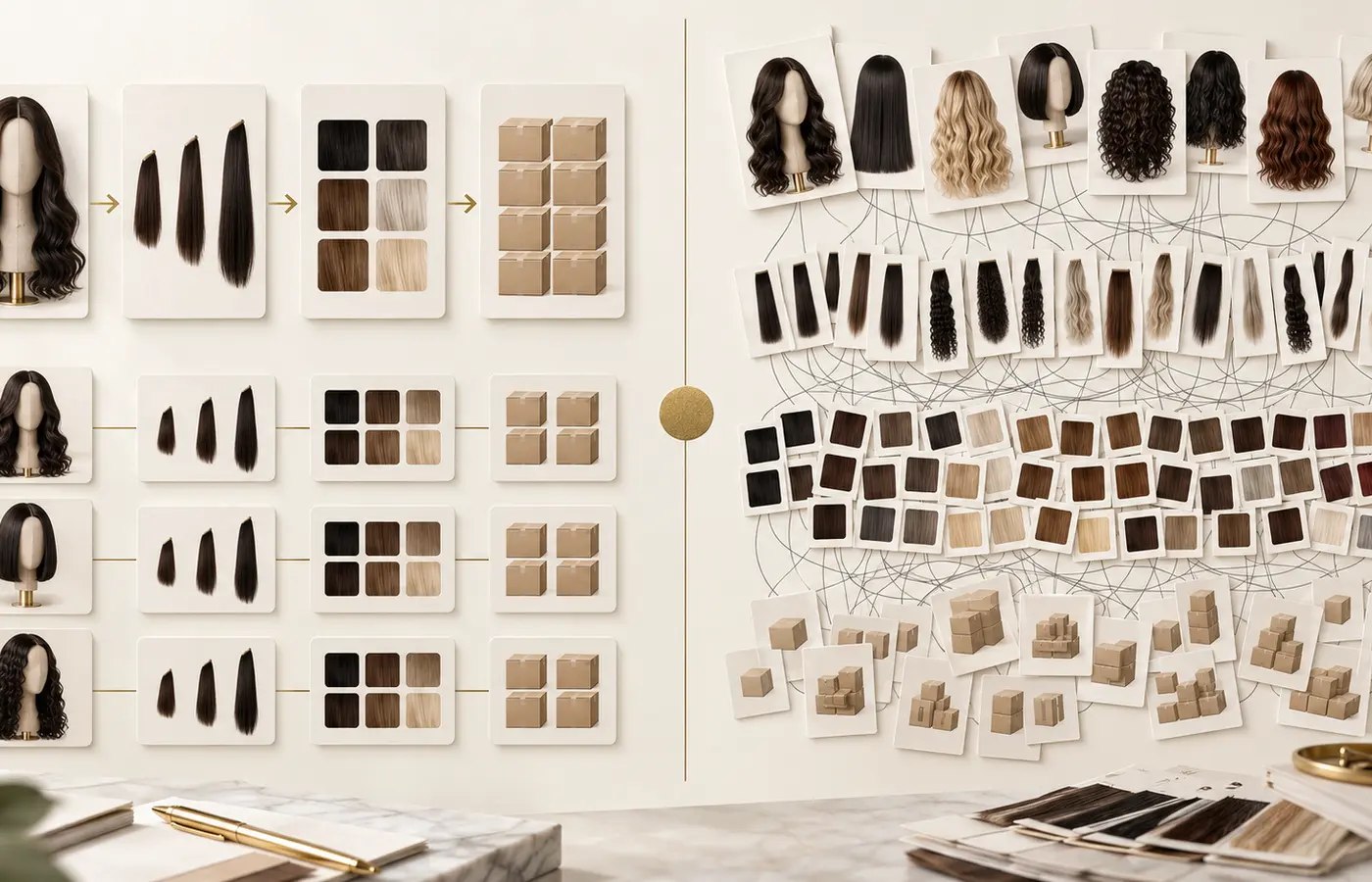
How to Build a Practical
First MOQ
Step 1: Define the target
customer
Specify the country, sales channel, expected retail position and main
use case. A salon-led range may need different constructions and
quantities from an online brand or regional distributor.
Step 2: Select a
focused group of hero styles
Begin with styles that clearly represent the planned collection. A
focused first launch usually provides cleaner sales data than a wide
range with only a few units per variation.
Step 3: Limit the number
of variables
Each additional length, color, density, texture and lace type creates
another SKU. Where possible, standardize shared components such as cap
construction, label placement and packaging size.
Step 4: Allocate quantity by
SKU
Do not divide the order evenly without considering likely demand.
Core lengths and natural colors may require deeper stock, while
experimental variations can receive smaller allocations if production
permits.
Step 5: Separate
product MOQ from packaging MOQ
Request a clear breakdown for wigs, labels, boxes, inserts and any
special accessories. This helps buyers understand which components
create the minimum.
Step
6: Plan replenishment before placing the first order
Ask about repeat-order lead time, material continuity and whether the
same packaging can be reused. A first MOQ is easier to manage when the
replenishment path is already defined.
Example MOQ Planning Matrix
The following is a planning example, not a fixed VAYORA
quotation:
| Decision layer | Focused launch | Complex launch |
|---|---|---|
| Wig constructions | 1–2 | 3 or more |
| Textures | 1–2 core textures | Several textures |
| Colors | Natural plus one tested option | Multiple custom colors |
| Lengths | Concentrated best-selling range | Broad length matrix |
| Density | One approved density per style | Multiple densities per style |
| Packaging | Shared box system | Different packaging by collection |
| Production risk | Easier to control | Higher setup and consistency burden |
The focused model does not have to mean a small brand identity. It
means using fewer manufacturing variables until demand and quality
standards are proven.
How Private Label Affects
MOQ
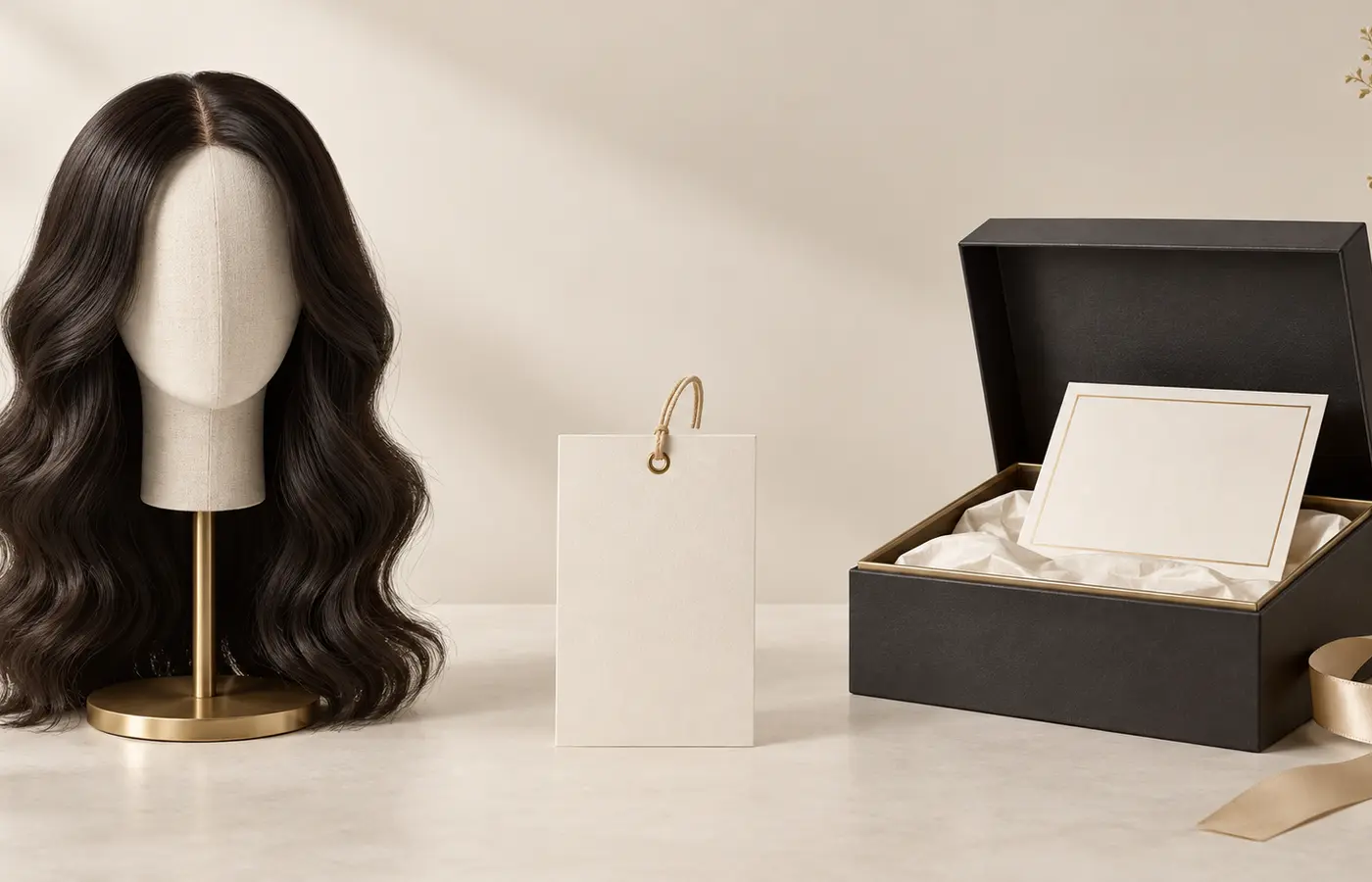
A private-label
wig project can include product labels, branded packaging,
instruction cards, barcode placement and other presentation
requirements. Each element should be divided into one of three
categories:
- Required for launch — essential brand elements
needed on the first order. - Can be standardized — components shared across all
SKUs. - Can be added later — optional elements that can
wait until sales volume grows.
This approach protects the brand presentation without making the
first production run unnecessarily complicated.
Common MOQ Planning Mistakes
Choosing only by the lowest
minimum
A low minimum does not guarantee suitable materials, repeatable
construction, strong communication or reliable delivery. Evaluate the
complete manufacturing process and quality controls.
Creating too many SKUs
A broad combination of lengths, colors and cap types can leave
insufficient quantity in each SKU and make quality approval more
complicated.
Approving packaging too late
Packaging dimensions, print files and label positions can affect the
shipment schedule. Approve them alongside the product rather than after
bulk wigs are completed.
Treating
the first sample as the production standard without documentation
Record measurements, weight, density, lace, color, texture and
packaging requirements. The approved sample should support a written
specification.
Ignoring inspection
quantities
The purchase plan should define how bulk units will be checked and
what happens when an item falls outside the agreed tolerance.
Information to
Send for an Accurate MOQ Review
To receive a meaningful assessment, send:
- Business type and target market
- Product references or specification sheets
- Required wig constructions
- Lengths, density, textures and colors
- Estimated quantity for each variation
- Custom cap or accessory requirements
- Logo, label and packaging needs
- Target delivery country and timing
- Sample requirements
- Expected repeat-order plan
VAYORA can then evaluate the product MOQ, packaging MOQ, sampling
steps and potential opportunities to consolidate specifications. See Samples & MOQ for the
current sourcing workflow.
Final Sourcing Takeaway
The most useful MOQ is not necessarily the smallest number. It is the
minimum production plan that supports clear specifications, consistent
quality, sensible SKU depth and a realistic replenishment path.
Buyers can reduce unnecessary complexity by focusing the first
assortment, approving samples carefully, standardizing shared components
and separating product quantities from packaging requirements.
Plan Your Sample and Bulk Order
Need an MOQ review for a new wig collection? Send VAYORA your styles, lengths, colors, quantity per SKU and branding requirements. We will review the sampling and bulk-production structure for your project.
Frequently Asked Questions
Is wig MOQ
calculated per order or per style?
It can be calculated by total order, style, color, length,
construction or custom component. Buyers should request a written MOQ
breakdown for their exact assortment.
Does a
sample order have the same MOQ as a bulk order?
Usually not. Samples are intended for evaluation and approval, while
bulk MOQ reflects commercial production, material preparation and
customization requirements.
Does
private-label packaging have a separate MOQ?
It often does. Boxes, labels, bags and inserts may have different
production minimums. Ask for product and packaging quantities
separately.
Can buyers mix
lengths or colors within the MOQ?
This depends on the product and manufacturing setup. Some
specifications can be consolidated, while custom colors or constructions
may require a minimum for each variation.
How can a new wig brand
manage MOQ risk?
Start with a focused assortment, concentrate quantity in core SKUs,
test samples, standardize packaging and plan replenishment before
expanding the range.