
Wholesale buyers often see “raw hair” and “virgin hair” used as
quality labels, but the terms alone do not provide enough information to
approve a wig program. Different suppliers may apply them differently,
and two products carrying the same label can perform very differently
after coloring, washing or bulk production.
For brands, salons and distributors, the practical question is not
which term sounds more premium. It is which material specification can
deliver the appearance, consistency, processing tolerance and price
position required for the intended collection.
This guide explains how raw and virgin hair are commonly positioned
in wholesale wig sourcing, what buyers should verify, and how sample
testing can turn broad marketing terms into measurable production
standards.
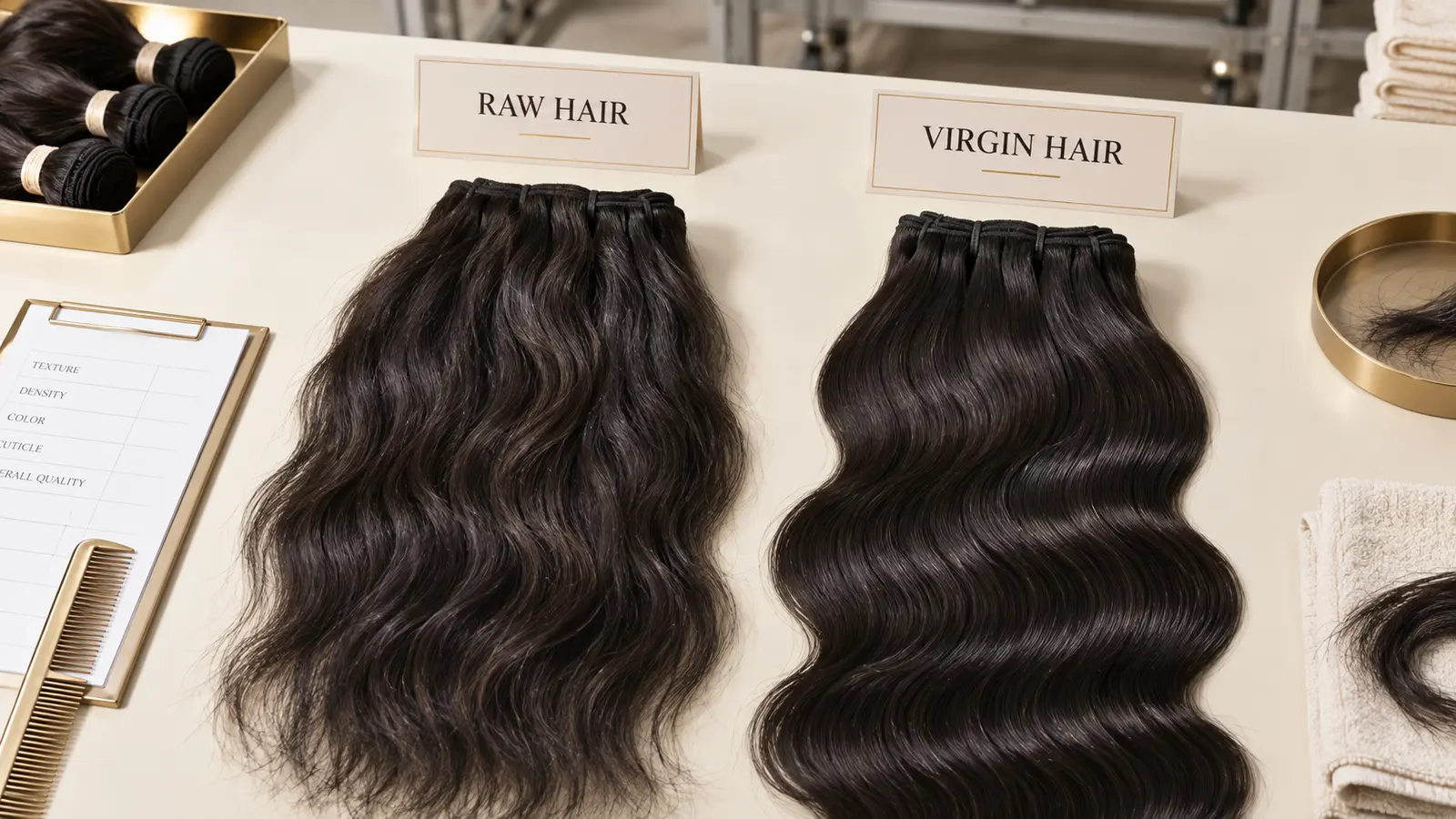
Raw Hair and
Virgin Hair: The Practical Difference
In wholesale conversations, raw hair generally
refers to human hair presented with minimal chemical processing. It is
often selected when the buyer wants a more natural variation, stronger
customization potential or a premium material story.
Virgin hair generally refers to human hair that has
not previously been used or worn. In commercial wig production, it may
still be processed to create consistent colors, textures or finishes for
a repeatable product line.
These descriptions are useful starting points, but they are not
universal grading standards. Buyers should therefore evaluate the actual
material, processing history and finished wig rather than approving an
order based only on the product name.
Buyer Tip: Treat “raw” and “virgin” as sourcing
categories that require supporting specifications—not as automatic proof
of quality.
Raw Hair vs Virgin Hair at
a Glance
| Sourcing factor | Raw hair | Virgin hair |
|---|---|---|
| Typical processing level | Minimal processing | May be processed for commercial consistency |
| Natural variation | Usually more visible | Often reduced through sorting and processing |
| Color uniformity | May vary between bundles or batches | Easier to standardize for repeat programs |
| Texture consistency | Can show natural variation | Can be produced in a broader, more consistent texture range |
| Light-color customization | Often selected for demanding custom work, subject to testing | Depends strongly on original material and prior processing |
| Batch repeatability | Requires careful sorting and approval standards | Often easier for scaled collections |
| Price positioning | Commonly premium | Covers mid-to-premium commercial ranges |
| Best use | Premium, natural-variation or customization-focused collections | Repeatable wholesale lines with defined textures, colors and price targets |
The table describes common sourcing patterns, not a guarantee. The
condition of the cuticle, strand alignment, previous chemical exposure,
sorting quality and construction process all affect the finished
wig.
Remy and Non-Remy: A Separate Question About Alignment
Raw and virgin describe a claimed material history; Remy describes whether the hair is collected and kept with strands running in the same root-to-tip direction. These labels can overlap. A product called virgin is not automatically Remy, and a Remy label alone does not establish that the hair was never processed.
| Buyer question | Remy direction | Non-Remy direction |
|---|---|---|
| Strand alignment | Root-to-tip direction is intended to remain aligned through collection and processing. | Mixed directions may be present, increasing cuticle friction if the cuticle remains. |
| Processing history | Alignment does not prove an unprocessed material. Ask separately about color and texture treatment. | Some material may be processed to reduce friction; confirm the treatment and post-wash performance. |
| What to test | Inspect tangling, shedding, ends and repeat-batch behavior after washing. | Repeat the same tests and record how the finish changes when coatings wash out. |
There is no universal grading certificate implied by these terms. Ask the supplier how the material was collected and sorted, what processing was used, and what variation is acceptable. Compare identified samples under the same wash, comb and color conditions; write the approved outcome into the product specification.
Connect hair selection to the quality-control reference and sample approval plan before confirming a repeat order.
Why the Label Alone Is Not
Enough
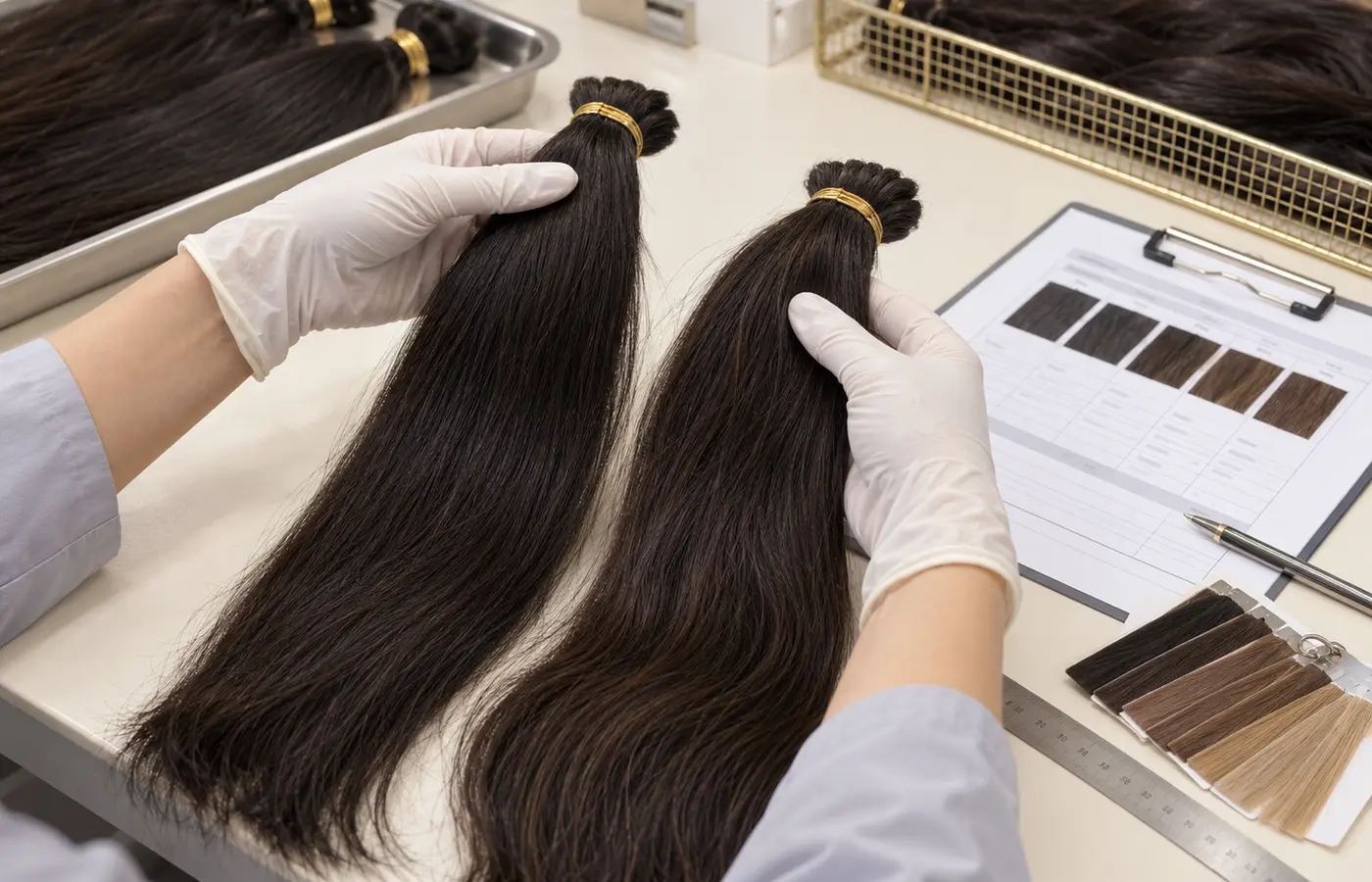
Terminology is not fully
standardized
There is no single global definition that every hair supplier uses in
exactly the same way. A buyer may receive very different materials under
the same “virgin hair” description, while one supplier’s raw hair may
have different sorting standards from another’s.
A reliable specification should go beyond the label and record:
- Material description and known processing history
- Intended texture and color
- Length range and short-hair allowance
- End fullness and drawn level, approved against matched physical samples
- Density and finished weight
- Cuticle and strand-direction expectations
- Accepted variation between units
- Shedding, tangling and combing standards
- Color-processing or bleaching target, when applicable
For an extension or bundle program, the single drawn vs double drawn buyer guide explains how strand-length mix changes end fullness and how to approve a matched sample.
Finished-wig
performance depends on more than hair origin
Hair quality cannot compensate for weak knots, poorly secured wefts,
uneven ventilation or inconsistent cap measurements. In the same way, a
well-constructed cap cannot fully correct unsuitable or overprocessed
hair material.
Wholesale evaluation should combine material inspection with the
construction checks described in VAYORA’s quality control
process.
When Raw Hair May Be the
Better Choice
Raw hair may suit a collection when the buyer prioritizes natural
appearance, premium positioning or advanced customization over maximum
batch uniformity.
Common applications include:
- Premium natural-color wig collections
- Products where subtle strand and color variation is acceptable
- Custom color programs that require a carefully tested base
material - Small, focused collections with higher price positioning
- Projects where buyers can approve controlled variation in
advance
However, “less processed” does not mean “no inspection required.”
Buyers should still check odor, strand alignment, ratio of shorter hair,
color variation, texture behavior, combing resistance and finished
construction.
For repeat orders, an approved sample should define how much natural
variation is commercially acceptable. Without that agreement, a material
valued for its natural character can create avoidable disputes during
bulk inspection.
When Virgin Hair May
Be the Better Choice
Virgin hair can be a practical option for brands and distributors
that need a stable assortment across multiple lengths, textures, colors
or price levels.
It may be better suited to:
- Repeatable wholesale wig collections
- Glueless, closure and frontal programs with defined
specifications - Product ranges that require consistent texture presentation
- Private-label collections with several SKUs
- Buyers balancing quality, commercial consistency and target
cost
The key question is how the material has been selected and processed.
Buyers should confirm whether the proposed color or texture is created
through steam processing, chemical treatment or other production
methods, and then test the finished wig accordingly.
Six Checks Wholesale
Buyers Should Make
1. Confirm the intended
market position
Start with the customer, retail price range and product promise. A
premium custom-color collection may require a different material
strategy from a high-volume natural-black glueless wig line.
2. Inspect
several units, not one presentation sample
One strong sample cannot show batch consistency. When possible,
compare multiple units or material lots for color, texture, fullness,
length and feel.
3. Test realistic color
processing
If the collection will include highlights, ombré, blonde shades or
custom toning, test the actual proposed material under the intended
process. Do not assume that every product labeled raw or virgin will
reach the same result.
4. Evaluate washing and
drying behavior
Record how the hair behaves after a controlled wash-and-dry cycle.
Check texture return, matting, tangling, excessive coating residue and
changes in appearance.
5. Check the finished wig
construction
Inspect knots, wefts, ventilation, cap measurements, lace placement,
density distribution and secure attachment points. Material and
construction must be approved together.
6. Define bulk tolerances
Agree on measurable tolerances for color variation, weight, length,
density, texture and workmanship. These standards should be reflected in
the approved sample and purchase specification.
VAYORA’s wig
sample order checklist provides a practical framework for recording
these results before bulk production.
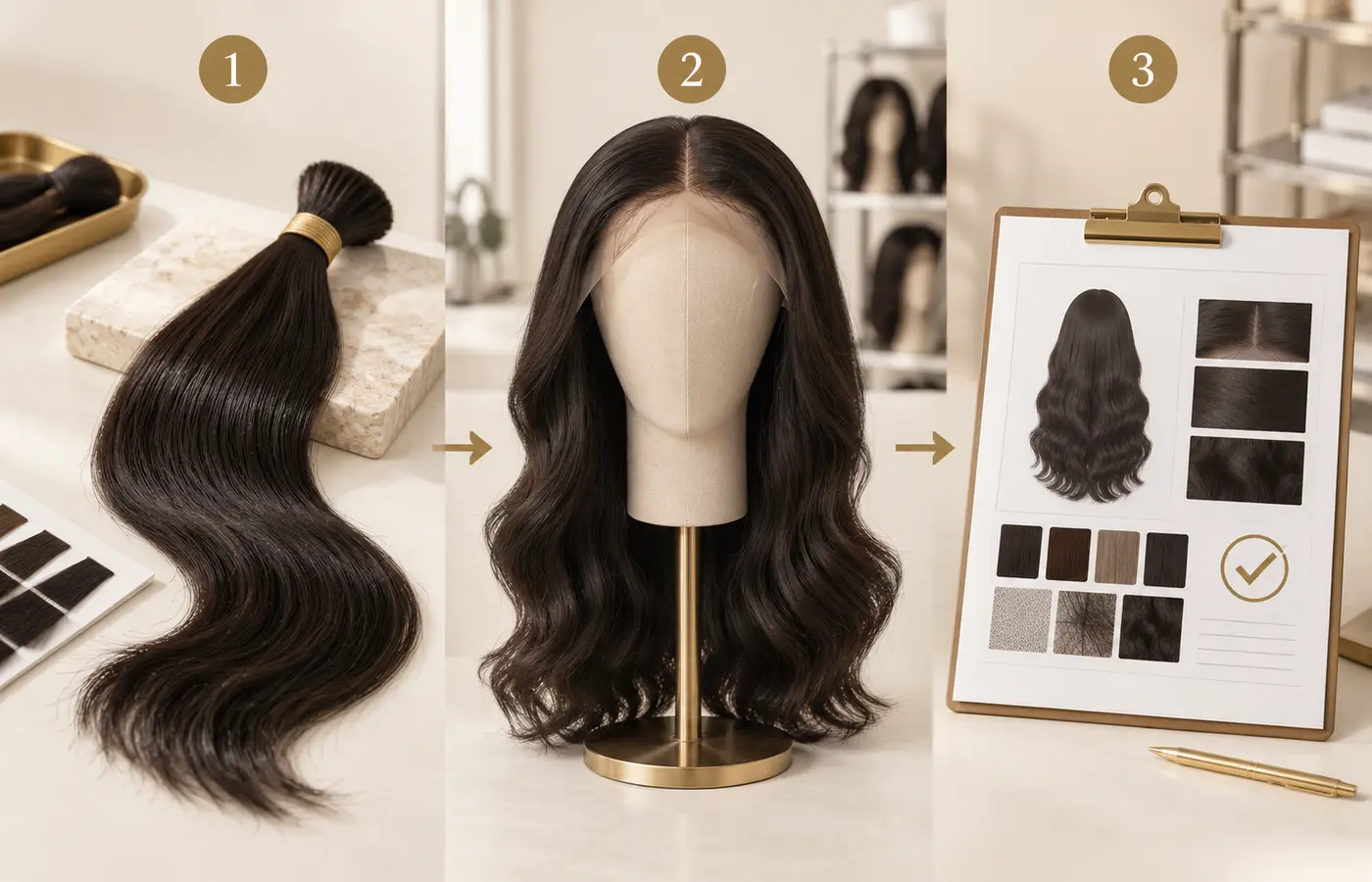
Raw or
Virgin Hair for OEM/ODM and Private Label Projects
The right material choice depends on the complete product brief. For
an OEM/ODM or private-label wig
project, buyers should provide:
- Target market and retail positioning
- Reference style or construction
- Required lengths, density and finished weight
- Texture and color range
- Lace or cap type
- Expected order quantity per SKU
- Packaging and label requirements
- Testing or compliance requirements
- Acceptable material and batch variation
The manufacturer can then evaluate whether raw hair, virgin hair or
another defined human-hair specification provides the best balance of
appearance, repeatability, customization and cost.
Questions to Ask a Hair
Manufacturer
Before approving the material, ask:
- How is this hair category defined in your quotation?
- What processing has the material received?
- How is color, texture and length consistency controlled?
- What variation should we expect between production batches?
- Can the proposed material meet our target color-processing
test? - Will the sample material match the material used for bulk
production? - Which inspection standards will be used before shipment?
Clear answers are more valuable than a premium-sounding grade name.
Buyers comparing suppliers can also use the criteria in How
to Choose a Reliable Human Hair Wig Manufacturer.
Final Sourcing Takeaway
Raw hair is often selected for minimal processing, natural variation
and premium customization potential. Virgin hair is often selected for
commercial consistency, broader product planning and repeatable
wholesale programs. Neither term should be treated as a complete
specification or a guarantee by itself.
The best choice is the material that passes the buyer’s sample tests,
supports the intended product position and can be reproduced within
agreed tolerances during bulk production.
Discuss Your Hair Material Requirements
Planning a raw-hair or virgin-hair wig collection? Send VAYORA your
target market, styles, colors, lengths, quantities and quality
requirements. Our team can review the specification and recommend a
suitable sampling path.
Remy Hair vs Processed Human Hair
These terms describe different dimensions. Remy refers to consistent root-to-tip cuticle alignment. Processed refers to treatments such as dyeing, bleaching, texture setting or surface coating. Remy hair can be processed; a processed wig can still be made from human hair. Neither label alone proves low tangling or wash durability.
| Question | Remy claim | Processed-hair claim | Buyer check |
|---|---|---|---|
| What is described? | Strand direction and cuticle alignment | Treatment history and resulting condition | Document material definition and sample history |
| What can vary? | Alignment quality, cuticle condition and mixed short hairs | Bleaching intensity, coating and texture stability | Comb, wash and dry the finished wig repeatedly |
| How to approve? | Check tangling and directional smoothness after washing | Check dryness, breakage, color and curl retention | Compare with an agreed reference sample |
Ask for the actual processing steps and intended target shade. Use the finished-wig quality evaluation and production QC framework rather than relying on grade names alone.
Can Remy hair be chemically processed?
Yes. Remy describes root-to-tip alignment, while processed describes treatments such as bleaching, dyeing or texture setting. A Remy sample should still be tested after the intended process.
Is processed human hair necessarily non-Remy?
No. Treatment history and cuticle alignment are separate characteristics. Ask the supplier to define both and verify the finished sample.
How should wholesale buyers compare Remy and processed wigs?
Use a written material definition and compare post-wash tangling, shedding, dryness, color and texture stability in finished wigs made to the target construction.
Frequently Asked Questions
Is raw hair always
better than virgin hair?
No. Raw hair may support premium positioning and demanding
customization, while virgin hair may provide better consistency for a
repeatable wholesale range. The better choice depends on the buyer’s
product brief and verified sample results.
Can all raw
hair be bleached to very light colors?
No result should be assumed from the label alone. Buyers should test
the proposed material using the intended color process and approve an
achievable standard before bulk production.
Why can two
virgin-hair wigs perform differently?
Suppliers may use different material definitions, sorting methods,
processing steps and construction standards. Buyers should compare
documented specifications and finished samples rather than relying only
on the grade name.
Should
raw and virgin hair be tested after wig construction?
Yes. Hair material, knots, wefts, ventilation and cap construction
work together. The finished wig should be tested, not only loose hair or
bundles.
Can
a private-label collection use both raw and virgin hair?
Yes. A brand may use different materials for different price levels
or product purposes, provided each range has clear specifications and is
tested separately.