
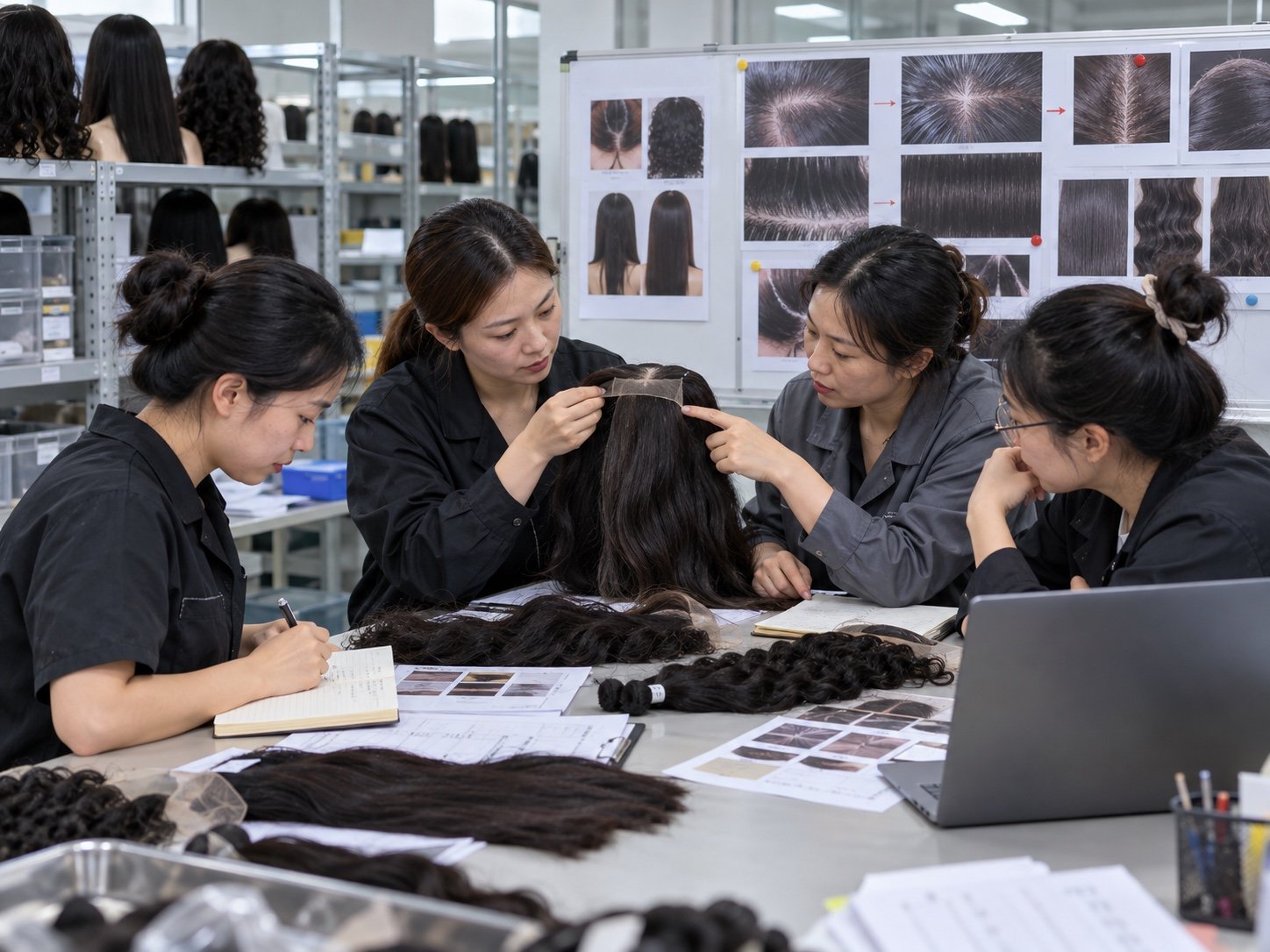

Why a complaint needs structured investigation
A customer complaint provides a signal, not a complete root-cause finding. The same SKU may perform differently across use environments, but varying experiences do not eliminate manufacturing responsibility. Wholesale teams should preserve evidence and compare the complaint against a defined baseline.
Step 1 — Record the case before altering the product
Capture buyer/order reference, SKU, lot or manufacturing batch if known, color, length, density, construction, complaint date, wear duration, exact tangle location, and clear photographs or video. Ask what occurred before the first tangle, without implying customer misuse.
Step 2 — Separate supplier and use variables
- Incoming material: source declaration and identification, fiber classification, donor-mix claims if documented.
- Processing: color lifting, acid washing, surface finishing and other treatments documented by the production team.
- Construction: ventilation direction, short return hairs, weft alignment, lace and cap details.
- Use: shampoo, conditioner, leave-in, heat, recoloring, humidity, storage and clothing contact.
Step 3 — Compare to the approved golden sample
Choose a retained or traceable comparison unit matched to the original specification. Examine dry combability, length and ends, color and texture, then inspect after a jointly agreed wash/dry sequence. Record any procedural differences. A single sample cannot establish defect frequency across a whole lot.
Step 4 — Assess failure patterns
Nape tangles, repeated root tangles, all-over roughness after washing and breakage following recoloring may point toward different investigative paths. Each remains a hypothesis until supported by examination and records. Avoid using “cuticles reversed” or “poor customer care” as automatic conclusions.
Step 5 — Document disposition and corrective action
Classify the outcome as confirmed manufacturing issue, likely use-related issue, mixed-factor issue or inconclusive, based on available evidence. Agree on customer remedy and whether the lot needs containment, additional inspection or supplier corrective action. Record the responsible owner and completion evidence.
Suggested sample acceptance record
| Check | Evidence to retain | Pass/fail rule |
|---|---|---|
| SKU and construction | Photo + specification | Match approved sample |
| Original condition | Dry combing video, ends and nape photos | Buyer-agreed benchmark |
| Wash conditions | Products, method, drying record | Specified procedure followed |
| After-wash tangling | Video/photos and observation log | Written acceptance criteria |
| Shedding/breakage | Method and observation | Agreed tolerance, if validated |
| Color/texture | Comparison against reference | Approved standard |
Questions for an RFQ or preproduction sample
Can the supplier identify hair treatment for this SKU? How is hair orientation managed during manufacture? What cleaning and detangling procedure is used for sample approval? Is a retained sample available? What photos and lot references will accompany bulk shipment? Which claims are independently substantiated?
How Vayora positions QC communication
Vayora’s sourcing content aims to help buyers define the specification and evidence they need. Specific wash-cycle observations, defect rates, cuticle findings or corrective-action outcomes should be supported by actual project records.
Conclusion
The strongest way to reduce disputes is to align expectations before production and investigate complaints using consistent evidence. A sample approved only for appearance cannot serve as a complete performance benchmark.
B2B Complaint Intake Record
| Field | Details to capture |
|---|---|
| Product | SKU, order, lot, texture, color, finished length, density, lace/cap type |
| Complaint | First occurrence, location (nape/roots/ends/all-over), severity, photos/video |
| History | Wash, conditioning, heat, coloring, wearing, storage, exposure conditions |
| Comparative evidence | Golden sample ID, retained sample, controlled wash/comb protocol, results |
| Production review | Source declaration, treatment history, assembly inspection; only where records exist |
| Outcome | Confirmed supplier / likely care / mixed / inconclusive, rationale, action owner, remedy |
Frequently Asked Questions
Does one complaint prove a batch is defective?
No. Investigate against other evidence and the agreed specification.
What is a golden sample?
A retained, approved reference unit and written specification used for comparison.
Should a supplier test after washing?
Yes, if after-wash performance is part of the agreed quality plan, with reproducible conditions.
How can a buyer distinguish care factors from production factors?
Assess batch and processing records alongside reported use and controlled sample comparison.
What corrective-action records should be kept?
Keep findings, root-cause rationale, containment decisions, agreed remedies and verification of changes.
Plan Your Wholesale Wig Quality Specification
Share your target style, length, color, volume, cap/lace details and your sample acceptance priorities. Ask Vayora about product options and evidence available for the specific SKU.
Related Products & Buyer Guides
- Human Hair Wig Inspection Guide
- Quality Control
- Golden Sample and Sample Approval
- Complaint and Corrective Action
- Samples & MOQ
- Private Label Wig Development
- Request a Quote
- Why Do Human Hair Wigs Tangle? Causes, Prevention & Buyer Checks
- How to Detangle a Human Hair Wig Safely: A Care and Escalation Guide