
Raw Material & Origin · Wholesale Buyer Guide
Vietnamese Raw Hair: A Wholesale Procurement Guide for Wigs and Extensions
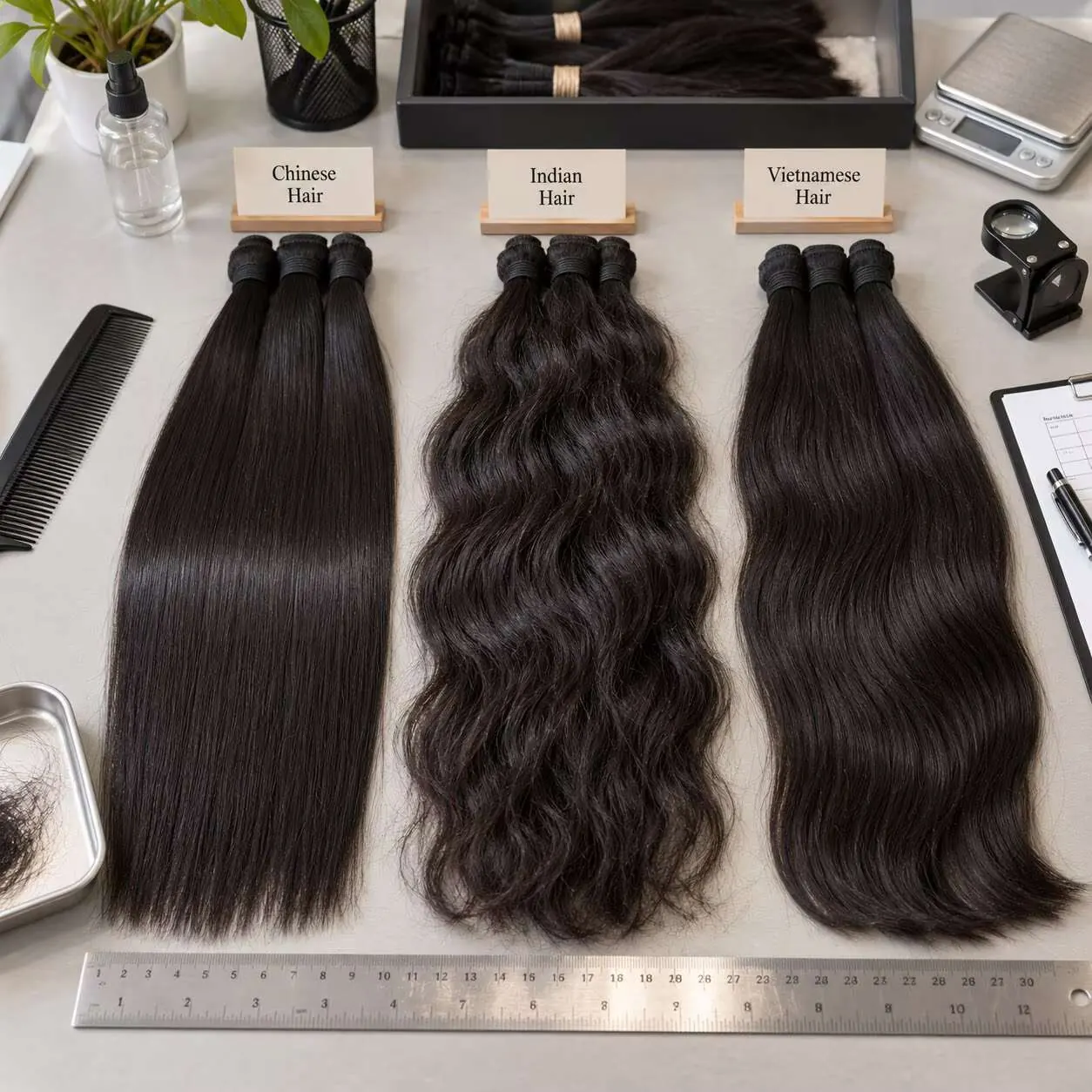
Vietnamese hair has become a major commercial keyword in wigs, bundles and extensions.
For B2B buyers, the most important discipline is to separate origin from quality grade.
A product can be Vietnamese-origin without being raw. A supplier can also use “raw,” “virgin,” “Remy” or “single donor” in different ways unless each term is defined in writing.
Vietnamese Hair Is a Sourcing Category, Not a Grade
Vietnamese hair identifies a claimed origin or sourcing category.
It does not, by itself, tell the buyer:
- donor structure
- cuticle condition
- previous color processing
- texture processing
- drawing level
- end fullness
- usable length
- wash performance
- repeat-order consistency
For that reason, Vayora’s sourcing framework records origin separately from the rest of the material specification.
This protects both the buyer and the manufacturer from vague expectations.
Raw, Virgin and Remy Need Separate Definitions
A supplier may describe hair as:
- Vietnamese Raw Hair
- Vietnamese Virgin Hair
- Vietnamese Remy Hair
- Vietnamese single-donor hair
These phrases are not automatically interchangeable.
A procurement specification should define:
Raw: what processing is excluded?
Virgin: does this mean no previous chemical color treatment, or something broader?
Remy: how is root-to-tip direction preserved?
Single donor: is one finished bundle truly from one donor, or is the term being used more loosely?
The more valuable the origin claim becomes in a brand’s marketing, the more important it is to document the supply-chain claim.
Long Lengths and Full Ends
Vietnamese hair is frequently marketed for long straight products.
For wholesale buyers, long length should be evaluated in practical terms.
Check:
- measured finished length
- percentage of strands that reach the stated length
- thickness in the final 4–6 inches
- total weight
- short-hair ratio
- natural taper vs double-drawn effect
- repeat availability at 24″+ lengths
A long wig that measures correctly but becomes extremely thin at the bottom may not meet a premium brand’s visual standard.
For 30–40 inch programs, the sample should be photographed and measured consistently so repeat production can be compared.
Natural Texture vs Processed Texture
Vietnamese-origin hair is often associated with straight or gently natural textures.
However, wholesale catalogs may also contain:
- body wave
- deep wave
- curly
- kinky straight
- other styled textures
These may be natural, steam-set, mechanically shaped or chemically processed depending on the supplier and product.
The buyer should therefore ask:
Is this texture natural to the material, or is it a manufacturing finish?
That distinction affects wash recovery, maintenance instructions and repeat consistency.
Color and Bleachability
Claims that Vietnamese hair can reach very light blonde shades are common in supplier marketing.
Do not treat that as a universal characteristic of the origin.
Instead, perform a controlled test on the proposed material.
Record:
- starting shade
- processing method
- lift achieved
- elasticity
- breakage
- dryness
- post-wash condition
For colored wig programs, the manufacturing process is just as important as the starting hair.
Product Applications
Vietnamese-origin hair may be considered for:
Wigs
Specify lace, cap, hairline, density, finished weight, hair length and end profile in addition to origin.
Bundles and Wefts
Specify bundle weight, usable length, drawing, seam/weft construction and shedding expectations.
Extensions
Specify attachment system, strand/pack count, color, usable length and any origin documentation required.
Closures and Frontals
Verify both material origin and lace/ventilation construction.
Origin should never replace the construction specification.
How to Approve a Vietnamese Hair Program
A structured approval sequence can include:
1. Define origin and processing terminology
2. Select target product specifications
3. Review current sample photos/video
4. Receive physical sample
5. Measure length, weight and end fullness
6. Conduct controlled wash test
7. Conduct color or heat test if relevant
8. Compare quality levels if available
9. Approve a golden sample
10. Define repeat-order tolerances
This converts a trendy sourcing term into an operational manufacturing standard.
FAQ
Is Vietnamese hair always raw?
No. Vietnamese-origin hair can be sold in raw, virgin, Remy or processed forms. Confirm the actual processing history.
Is all Vietnamese hair single donor?
No. Single donor is a separate claim that requires its own verification.
Is Vietnamese hair good for long straight wigs?
It can be suitable, but buyers should verify real usable length, end fullness, processing and repeat availability.
Can Vietnamese hair be made into curly textures?
Yes, commercial suppliers offer various textures, but buyers should confirm whether the texture is natural or processed and how it behaves after washing.
How should a brand describe Vietnamese origin publicly?
Only make product-level origin claims that match the documented supply chain. Do not imply that Vayora owns a Vietnamese factory unless that is factually true.
Build a Vietnamese Hair Program Around a Written Specification
Share your target wig, bundle or extension type, length, texture, quality level, color requirement and order plan.
Vayora can help organize the sampling and approval process before bulk production.
Explore wholesale wig options, hair extensions and private label development after defining the material specification.
Request a QuotePlan Samples & MOQ