
Raw Material & Origin · Wholesale Buyer Guide
European and Slavic Hair for Premium Wigs: A Wholesale Sourcing Guide
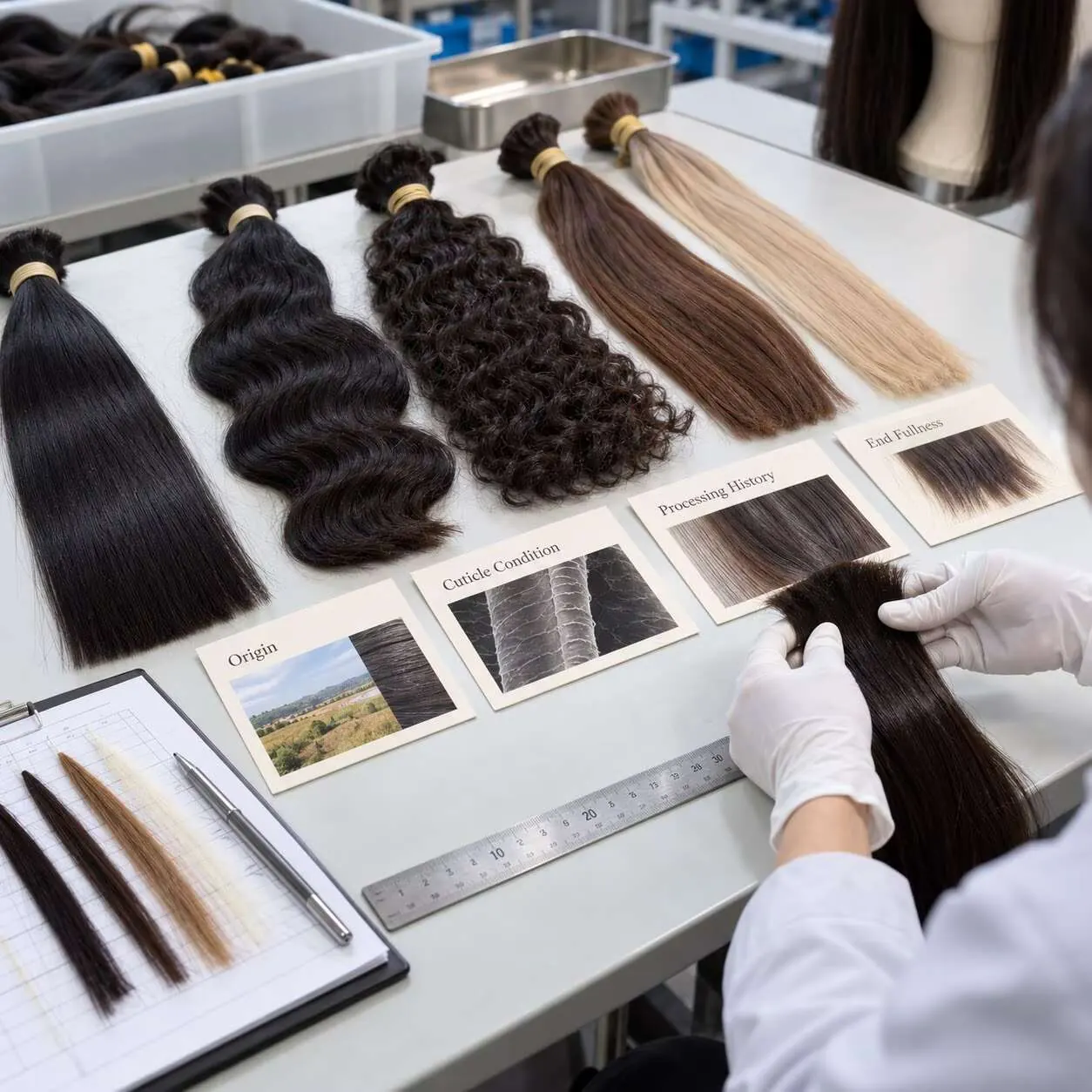
European and Slavic hair occupy a specialized premium position in the human-hair market.
Buyers often seek these materials for luxury wigs, toppers and extensions where fine texture, natural movement and naturally lighter shades are commercially important.
The premium positioning also creates a major sourcing challenge: the more valuable the origin label becomes, the more carefully it should be verified.
What Buyers Mean by European or Slavic Hair
In the trade, terms such as European Hair, Slavic Hair and Russian Hair may be used to describe hair sourced from parts of Europe or Eastern Europe.
These labels are not automatically interchangeable.
A serious buyer should ask the supplier to define:
- claimed country or region of origin
- collection and sorting route
- donor structure
- natural shade
- previous processing
- cuticle condition
- available lengths
- repeat-order capacity
The final retail claim should never be broader or more specific than the documentation supports.
Why the Category Commands a Premium
Premium European/Slavic material is commonly sought for a combination of:
- fine strand feel
- soft movement
- naturally lighter shade availability
- suitability for high-end wigs and toppers
- reduced need for aggressive lightening in some color programs
Those characteristics can be valuable when a brand is serving customers who want a lighter, finer or very natural-looking result.
However, they should still be confirmed on the actual sample.
“European” is not a substitute for a performance test.
Natural Shade Range and Fine Texture
One of the key commercial advantages of genuine European-origin hair can be the availability of natural dark blonde, light brown and related shades.
Starting closer to the target color can reduce the amount of color processing required for some products.
For premium toppers and wigs, fine strand texture can also help with movement and blending.
But natural characteristics vary.
The buyer should record:
- shade under controlled lighting
- strand diameter or feel
- amount of gray if relevant
- natural texture
- density
- end profile
Natural variation should be expected unless the supplier performs additional sorting.
Scarcity and Repeat-Order Risk
Premium origin claims are not only a quality question.
They are a supply question.
If a brand plans a recurring European-hair SKU, it should ask:
- Can the same shade range be supplied again?
- Are long lengths available repeatedly?
- How much natural variation should be expected?
- Is material allocated by lot?
- What happens if the exact shade is unavailable?
- Can a blend or substitute be used, and if so, how will it be approved?
A material that produces an exceptional first sample but cannot support repeat production may not be appropriate for a scalable retail SKU.
Origin Verification
European/Slavic origin should be treated as a documentation field.
Useful controls can include:
- supplier declaration
- lot/batch records
- country or regional sourcing record where available
- purchase documentation
- written product specification
- approved physical sample
No single photograph can prove geographic origin.
If origin is central to the buyer’s marketing, the evidence standard should be decided before placing the bulk order.
Best-Fit Product Categories
Depending on the lot and target market, European/Slavic hair may be considered for:
Premium Wigs
Especially where fine texture and natural lighter shades are commercially valuable.
Women’s Toppers
Useful where blending with lighter or finer natural hair is important.
Custom Hairpieces
Suitable for low-volume, high-specification pieces where material matching is critical.
Premium Extensions
Potentially useful for clients who want natural lighter shades or a fine strand profile.
The buyer should still evaluate construction, lifespan expectations and replacement availability.
How to Build a Premium European-Hair Specification
A useful specification can include:
1. Claimed origin / sourcing region
2. Natural shade
3. Strand profile
4. Natural texture
5. Donor structure
6. Cuticle condition
7. Processing history
8. Length and end fullness
9. Finished weight
10. Construction method
11. Wash/styling requirement
12. Shade-matching tolerance
13. Repeat-order availability
14. Golden-sample approval
This makes the premium price easier to connect to measurable product requirements.
FAQ
Is European Hair the same as Slavic Hair?
Not necessarily. Suppliers may use the terms differently. Ask for the exact sourcing definition.
Is European Hair naturally blonde?
Some European-origin lots can include naturally lighter shades, but not all European hair is blonde.
Is European Hair always better than Asian hair?
No. It serves a different sourcing need. The correct choice depends on strand characteristics, color, product type, availability, budget and repeatability.
Why is genuine European/Slavic hair expensive?
Premium pricing can reflect limited supply, natural shade selection, strand characteristics, sorting and sourcing complexity.
Is it suitable for high-volume programs?
Sometimes, but buyers should evaluate repeat availability carefully before building a large recurring SKU around a scarce material.
Developing a Premium Wig or Topper Range?
Send Vayora your target shade, strand feel, length, construction and expected order volume.
We can help compare premium material options around the product requirements that matter most.
Explore wholesale wig options, hair extensions and private label development after defining the material specification.
Request a QuotePlan Samples & MOQ