
Raw Material & Origin · Wholesale Buyer Guide
What Is Chinese Ponytail Hair? A Wholesale Buyer’s Guide
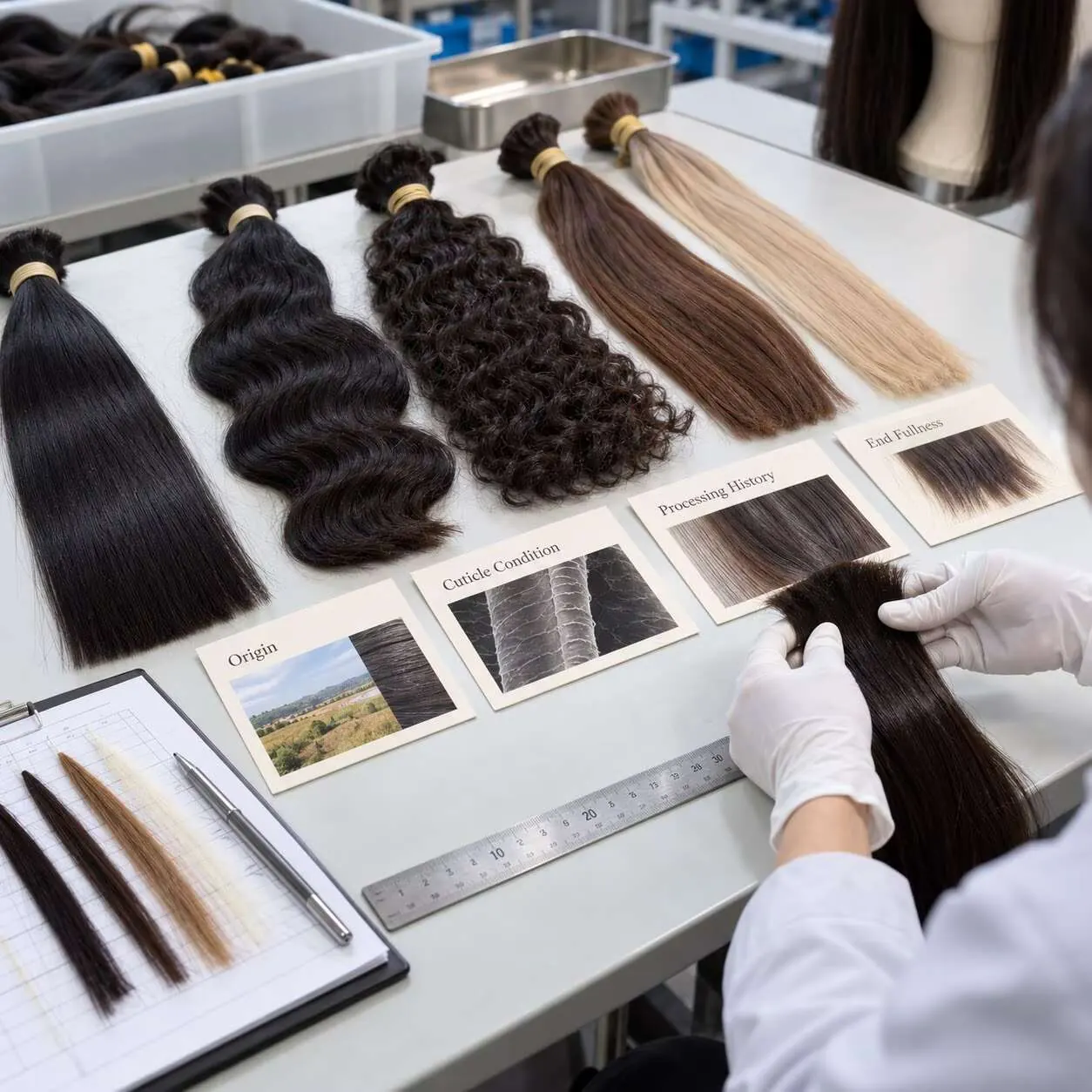
“Chinese ponytail hair” is a term used in parts of the human-hair trade to describe hair collected and kept together in a tied ponytail or braid-like bundle so the original strand direction can be preserved.
For wholesale buyers, the important point is not the name itself.
The important point is whether the proposed lot actually has the characteristics required for the intended wig, topper, hair system or extension program.
What Buyers Mean by Chinese Ponytail Hair
In professional sourcing conversations, ponytail-collected hair generally refers to hair that has been cut while bound so that the root and tip direction can remain identifiable.
That can make it easier to preserve alignment than with loose floor hair, comb waste or material that has been mixed without directional control.
However, the phrase Chinese ponytail hair can still cover many different commercial grades.
It does not automatically tell the buyer:
- whether the lot is single donor
- whether it is raw or previously processed
- whether the cuticle is fully intact
- whether the hair has been dyed
- how heavily it has been sorted
- what percentage of strands are full length
- whether different ponytails were later mixed
- whether surface coatings were used
Those points need separate confirmation.
Ponytail Collection Does Not Automatically Define Grade
A tied collection method can help preserve direction, but final quality still depends on what happens afterward.
Material can be affected by:
- cleaning and disinfection
- color sorting
- chemical processing
- texture modification
- cuticle treatment
- silicone or finishing agents
- donor mixing
- drawing and length sorting
- storage conditions
This is why two suppliers can both use the term “Chinese ponytail hair” while offering very different performance.
For Vayora-style B2B sourcing, the commercial name should always be converted into a written specification.
What to Check in a Proposed Lot
Root-to-Tip Alignment
Ask how direction is preserved during collection, cleaning and sorting.
Processing History
Confirm whether the material has been dyed, lightened, chemically straightened, permed or coated.
Donor Structure
Ask whether the lot is single donor, few donor or multi-donor. Do not assume ponytail automatically means one donor per finished bundle.
Strand Diameter
Chinese-origin lots can vary. If a particular strand feel is important for a topper, men’s system or luxury wig, approve the actual sample rather than relying on a national stereotype.
End Fullness
Measure not only nominal length but also the thickness and percentage of long strands through the final inches.
Color-Lift Requirement
If the product will be heavily colored, approve a controlled test on the exact proposed material.
Where It Can Fit in Product Development
Depending on the selected batch and processing plan, Chinese ponytail material may be considered for:
- premium human-hair wigs
- women’s toppers
- men’s hair systems
- custom ventilated pieces
- wefts and bundles
- selected extension systems
- custom-color programs
Different applications require different specifications.
For example, a men’s hair system may prioritize fine knotting behavior, strand selection and natural movement, while a 30-inch wig may place greater emphasis on long-length availability, full ends and color-processing stability.
Chinese Ponytail Hair vs Processed Commercial Hair
The key difference should not be framed as “ponytail good, commercial hair bad.”
Commercially sorted multi-donor hair can be suitable for many large-scale programs when the specification is clear and the process is controlled.
Ponytail-collected material may be more attractive where the buyer prioritizes traceable direction, lower processing, natural variation or premium positioning.
The correct choice depends on:
- target retail price
- product category
- required volume
- acceptable natural variation
- color-processing plan
- repeat-order demand
- target lifespan and customer expectations
Testing Before Bulk Production
A buyer considering Chinese ponytail material should test the actual proposed lot or representative sample.
Recommended checks include:
- visual inspection before washing
- controlled wash and detangling
- end-fullness measurement
- strand-strength comparison
- heat styling if relevant
- color lift if relevant
- texture recovery after washing
- comparison against a golden sample
If the business requires repeat monthly production, availability and batch-to-batch consistency should be evaluated as carefully as first-sample performance.
Questions to Ask a Supplier
1. What exactly does “Chinese ponytail hair” mean in your specification?
2. Is the lot single donor, few donor or multi-donor?
3. Has the hair been chemically colored or texture processed?
4. How is root-to-tip direction preserved?
5. What drawing or end-fullness level is supplied?
6. What lengths are consistently available for repeat production?
7. Can the proposed lot be wash-tested before approval?
8. Can you provide two quality levels for comparison?
9. How do you control bulk production against the approved sample?
10. What origin and processing claims can be documented?
FAQ
Is Chinese ponytail hair the same as Raw Hair?
Not necessarily. Ponytail describes a collection format; Raw Hair is a processing claim. Both need separate definition.
Is all Chinese hair thick or coarse?
No. Strand characteristics vary. Approve the actual lot rather than relying on a generalized origin stereotype.
Is Chinese ponytail hair suitable for toppers?
It can be, depending on strand feel, color, construction and the target wearer. A topper program should be developed from samples.
Can it be used for long wigs?
Potentially, but long-length supply, end fullness and repeat availability must be confirmed.
Is it always single donor?
No. A ponytail may originate from one donor, but commercial lots can later be sorted or combined. Confirm donor structure explicitly.
Evaluate Chinese Ponytail Hair for Your Product Program
Send Vayora your intended product, length, texture, color-processing requirement, end-fullness target and order plan.
We can help translate a raw-material label into a sample specification that can be evaluated before bulk production.
Explore wholesale wig options, hair extensions and private label development after defining the material specification.
Request a QuotePlan Samples & MOQ