
Raw Material & Origin · Wholesale Buyer Guide
Indian Temple Hair for Wholesale Wigs: What Buyers Should Verify
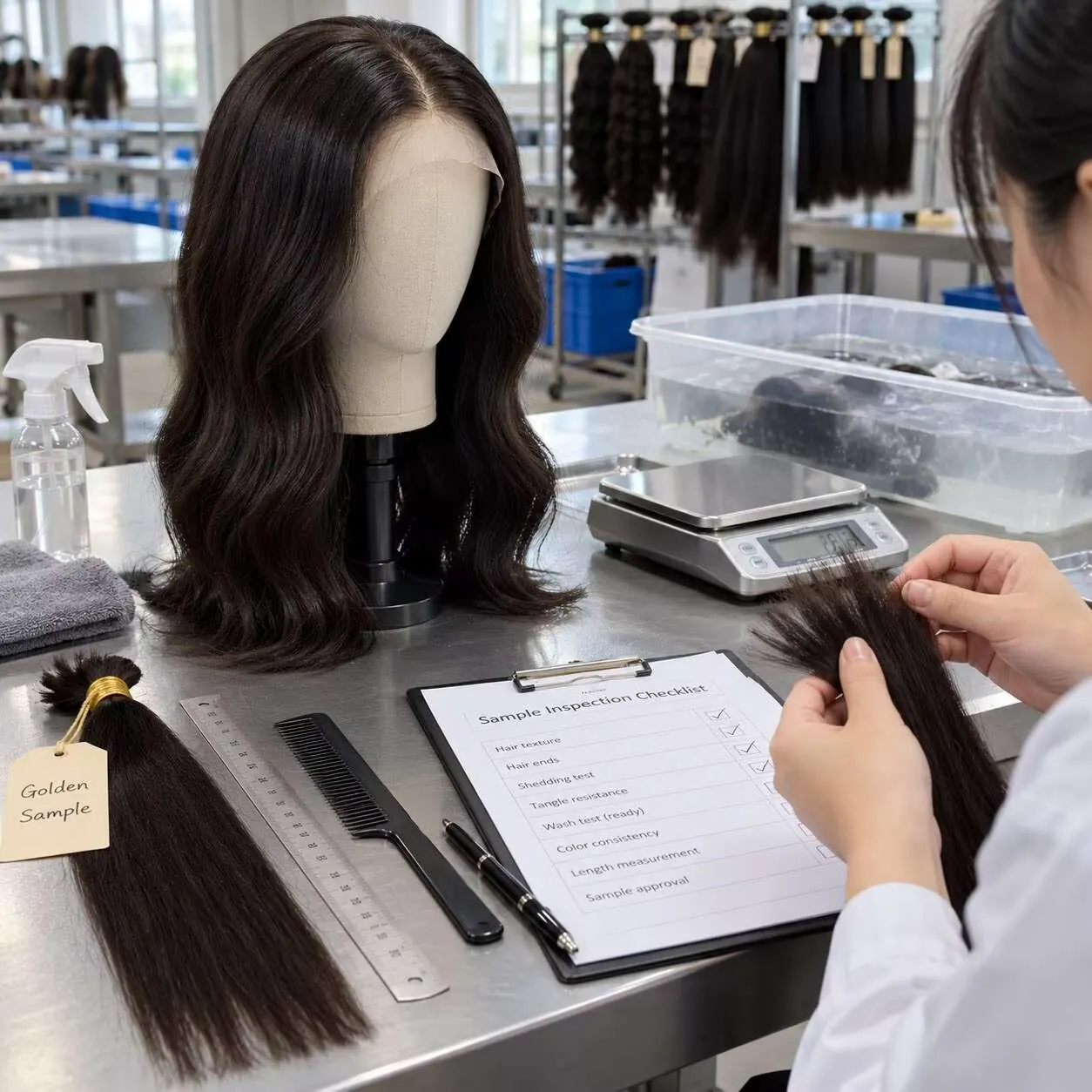
Indian Temple Hair is one of the most recognized origin terms in the international human-hair trade.
For wholesale buyers, however, the name should begin a verification process rather than end it.
The buyer needs to separate three questions:
1. **Where was the hair collected?**
2. **How was it handled after collection?**
3. **What specification will actually be supplied in the finished product?**
What Indian Temple Hair Means
The term generally refers to human hair collected through tonsure or hair-offering practices at temples in India.
In trade, this material may be sold as bulk hair, wefts, bundles, closures, frontals, wigs or extension products.
Because hair can be tied or kept in directional lots during collection and sorting, premium suppliers often emphasize root-to-tip cuticle alignment.
But a temple-origin story alone does not prove final grade.
After collection, the hair can still be cleaned, sorted, mixed, colored, textured, drawn or finished in different ways.
Temple Origin and Raw Hair Are Different Claims
“Temple Hair” describes a sourcing route.
“Raw Hair” usually describes an asserted processing condition.
These are not the same statement.
A buyer should ask:
- Was the lot chemically colored?
- Was the natural texture altered?
- Was the cuticle acid-treated?
- Was silicone or another coating applied?
- Were multiple donor lots blended?
- Was the hair steam-textured or otherwise modified?
- What cleaning process was used?
A supplier may legitimately sell temple-origin material in more than one processed form.
The written specification needs to state which form the buyer is approving.
Cuticle Direction and Donor Structure
Premium Indian Temple Hair is often marketed as cuticle-intact and root-to-tip aligned.
This is commercially important because directional control can influence tangling and handling.
However, cuticle-aligned and single donor are not identical claims.
A multi-donor lot can still be directionally aligned if the hair is sorted correctly.
Likewise, a single-donor bundle can later be damaged by aggressive processing.
The buyer should therefore record:
- donor structure
- cuticle condition
- alignment method
- processing history
as separate fields.
Natural Variation Is Normal
Raw or minimally processed hair can show natural variation in:
- wave pattern
- strand diameter
- natural black/brown shade
- end taper
- density
- response to humidity
This variation can be desirable for some premium products because it preserves a more natural material character.
For other programs, especially repeat retail SKUs, buyers may prefer more sorting and standardization.
The correct specification depends on the brand’s end customer.
Color Processing and Bleach Claims
Claims such as “bleaches to #613” are common in the trade.
Buyers should treat them as testable performance claims rather than guaranteed properties of all Indian Temple Hair.
Color lift can vary according to:
- natural pigment
- previous chemical exposure
- strand strength
- donor variation
- processing formula
- developer strength
- temperature and time
Before launching blonde or custom-color production, perform a controlled strand or sample test.
Document the result and define an acceptable processing window.
Applications for Wigs and Extensions
Depending on grade and processing, Indian-origin material can be considered for:
- lace wigs
- full-lace wigs
- bundles and wefts
- closures and frontals
- toppers
- custom pieces
- tape-in, keratin and other extensions
- custom-color programs
The raw material should still be matched to the construction.
For example, a wig intended for repeated color processing may require different selection standards from an extension line sold primarily in natural black.
Wholesale Verification Checklist
Before approving Indian Temple Hair, ask the supplier to define:
1. Sourcing category and origin
2. Raw / virgin / processed status
3. Donor structure
4. Cuticle condition
5. Root-to-tip alignment
6. Natural or processed texture
7. Drawing level
8. Length tolerance
9. Weight tolerance
10. End-fullness target
11. Color-lift requirement if applicable
12. Wash-performance standard
13. Golden-sample control
14. Repeat-order availability
A serious B2B program should turn all of these into a controlled specification rather than relying on the phrase “Indian Temple Hair” alone.
FAQ
Is Indian Temple Hair always single donor?
No. Some lots may be single donor while others may be few donor or sorted multi-donor. Confirm the specific lot structure.
Is Temple Hair automatically Remy?
Not automatically. Directional handling can support Remy-style alignment, but the finished lot still needs verification.
Can Indian Temple Hair be bleached?
Some high-quality lots can be processed to lighter shades, but performance varies. Test the exact proposed material and process.
Is natural variation a defect?
Not necessarily. Minimally processed material can show natural variation. Whether that is acceptable depends on the buyer’s product standard.
What should a buyer approve before bulk production?
Approve the actual sample, written specification, relevant wash/color tests and golden-sample reference.
Source Indian-Origin Hair by Specification, Not by Label
Tell Vayora the product format, length, texture, color plan, quality target and expected order scale.
We can structure the development process around measurable sample and production requirements.
Explore wholesale wig options, hair extensions and private label development after defining the material specification.
Request a QuotePlan Samples & MOQ