
How to Build a Focused 5-SKU Glueless Wig Collection
A new collection does not need twenty products to communicate a clear market position. For many buyers, a smaller test range can make sampling, specification control, inventory planning and customer feedback easier to manage.

The framework below uses five product roles to show how a glueless range can be structured. It is an illustrative assortment model—not a list of guaranteed best sellers. Final products should reflect the buyer’s market, channel, target retail price, customer and sample results.
Start With Customer Roles, Not Five Random Styles
Each SKU should answer a different reason for being in the range. If two products serve the same customer, same wearing occasion and same price position, the second SKU may add complexity without adding meaningful choice.
Use five roles: Everyday Hero · Premium Upgrade · Texture Direction · Short/Easy Direction · Visual Color Direction.
Core easy-wear proposition
A clear reason to trade up
A defined texture preference
A distinct shorter silhouette
A controlled color accent
SKU 1: Everyday Hero
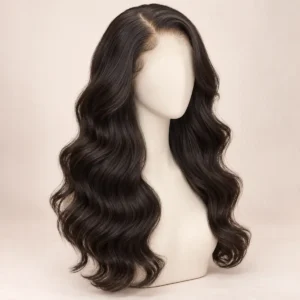
Purpose: establish the clearest expression of the brand’s core easy-wear proposition.
Illustrative direction: a controlled glueless straight or body-wave construction, potentially using a 5×5-style direction where that matches the approved product and market.
Define: intended customer, lace, cap/security, hairline, length, finished weight/fullness, pre-everything requirements and target price position.
Do not multiply lengths before the hero construction itself is approved.
SKU 2: Premium Upgrade
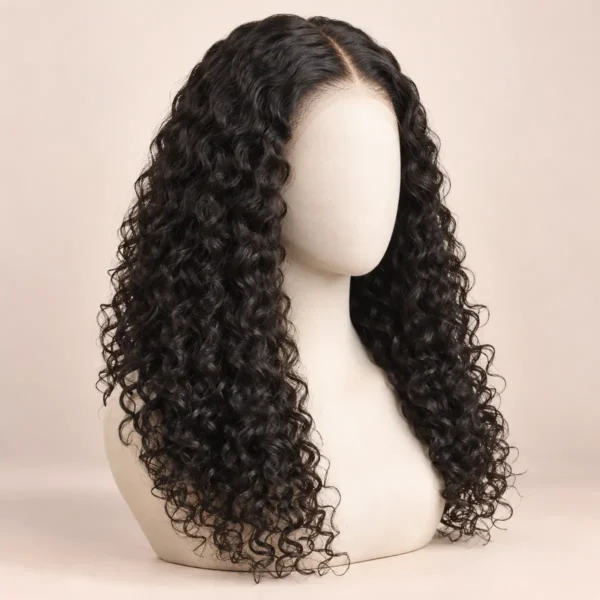
Purpose: give the customer a reason to trade up.
The upgrade should be visible or experiential—not simply a higher price. Depending on the brand, that difference could come from a larger lace area, more flexible parting, more refined hairline work, different hair specification, lighter balance, custom color or packaging.
Buyer test: can a salesperson explain the upgrade in one or two sentences without relying on vague words such as 'better' or 'luxury'?
SKU 3: Texture Direction
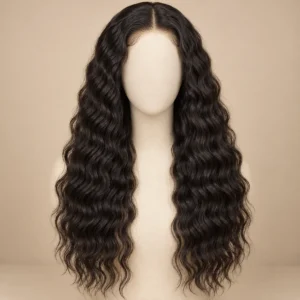
Purpose: serve a clearly defined texture preference rather than treating texture as a decorative variation.
Illustrative directions may include kinky-straight or another natural-texture concept appropriate to the buyer’s audience. The chosen texture must be sampled for appearance, movement, consistency and how it interacts with the glueless construction.
Avoid launching many texture/length combinations before identifying which role earns repeat demand.
SKU 4: Short / Easy-Wear Direction

Purpose: introduce a visually distinct, potentially lower-maintenance silhouette.
A bob or other shorter direction can broaden the collection without relying on another long-hair variation. Construction, weight, hairline and cut consistency become especially visible in shorter styles.
Approve the finished shape, not only the nominal length.
SKU 5: Visual Color Direction

Purpose: create a controlled visual accent for channels where color and social presentation matter.
This might be a highlight, balayage or selected color direction, but the role should remain controlled. Color adds production and inventory complexity, so the first test does not need every length and texture.
Approve color placement, tone, base color, root treatment where applicable and the physical sample under consistent lighting.
Five roles × one approved variation = five test SKUs
Five roles × three lengths × two colors = thirty combinations
Keep Length and Color Multiplication Under Control
Five product roles can quickly become dozens of SKUs if every role is multiplied by several lengths and colors. That may be appropriate later, but it weakens the value of a focused market test.
Begin with the smallest matrix that can answer the commercial question: Which product role deserves expansion?
Approve each product role
Record specification and sample version
Gather actual buyer/channel feedback
Add only evidence-supported variations
Sample Before Expanding the Matrix
Approve each role as a physical product. Record the specification, sample version, photos, measurements and key finishing notes. Then use actual buyer/customer feedback, channel performance and repeat demand to decide which role should receive additional lengths, colors or textures.
Review glueless as a complete product platform, then use the test-before-scaling process to decide which approved role earns expansion.
Ready to customize the assortment? Turn the Framework Into a Development Brief →
Start With a Collection You Can Learn From
Tell VAYORA your market, target customer, price position and launch size. Use a focused assortment to move from idea to sample before expanding the matrix.
Framework & Evidence Boundary
This is an illustrative collection-planning framework from the approved VAYORA editorial master. It is not a sales ranking, a best-seller claim or a universal U.S. assortment recommendation. No external market statistic or customer result is claimed.