
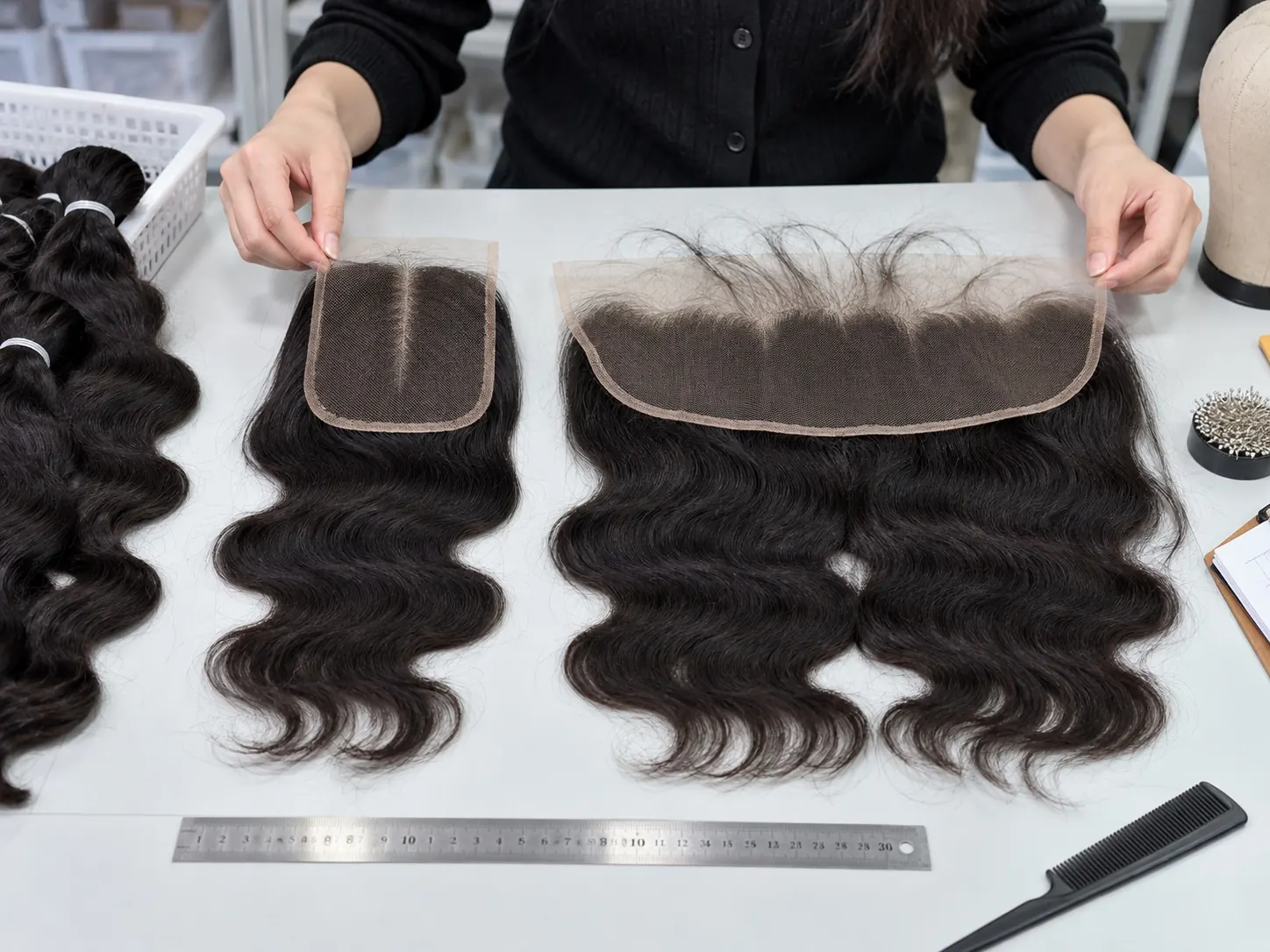
The Main Difference
A closure covers a smaller top or parting area, while a frontal extends across a wider front hairline area. For buyers, this changes lace consumption, ventilation work, styling flexibility, installation and QC risk.
Typical Closure Formats
Common closure formats include compact top pieces such as 4×4 or 5×5 directions, depending on the program. The exact usable parting area and finished dimensions should be confirmed by sample.
Typical Frontal Formats
Frontals cover a wider area across the front. Common commercial directions may include 13×4 or 13×6 constructions, but exact lace shape, hairline and ventilation density should be confirmed with the supplier.
How Wholesale Buyers Should Compare Them
- Lace area and material.
- Parting flexibility.
- Hairline realism.
- Ventilation density.
- Installation complexity.
- Matching with bundles or wig body.
- Packaging protection.
- Inspection and defect risk.
Matching Closures / Frontals With Bundles
Select the component for the intended coverage and assembly. A separate closure and a frontal component require their own lace dimensions, parting and hair-distribution standards. Match their presentation with the bundle assortment; unlike products do not need identical weight or density labels.
| Matching field | Buyer approval | Packing / repeat control |
|---|---|---|
| Texture | Same preparation, comparable views and physical references | Retain component and bundle master IDs, not texture names alone |
| Color | Compare root, mid-length and ends under recorded lighting | Link approved shade references to each SKU |
| Length / fullness | Confirm measurement condition and the intended combined silhouette | Keep per-component standards; do not convert density to bundle grams |
| Set contents | Identify each bundle length, lace piece and quantity | Sales-set code linked to the component packing list |
| Packaging | Protect lace/edges and keep length/color identification visible | Approve label, barcode, insert and artwork version |
| Change control | Review a changed component, shade or processing before bulk/reorder | Update affected SKU/set references and release approval |
Approve the Set Before Bulk Allocation
- Record the bundle and lace-component scope with quantities per SKU.
- Review physical samples together in the same preparation/lighting condition.
- List mismatches by component and reference zone; revise and approve the retained set.
- Confirm labels and packing allocation against the set code before release.
Use specification-led QC and sample planning. Tolerances, inspection quantities and acceptance criteria are project-approved; no perfect-batch match or numerical color result is implied.
Discuss Your Project
Send Vayora your desired lace size, hair quality, texture, color and bundle matching requirement for closure or frontal sampling.
Request a Quote