
Glueless Wig Cap Construction: A Buyer’s Guide
Fit depends on the complete cap and adjustment system. A label such as glueless does not specify component position, dimensions or wearer conditions.
Why Cap Construction Matters
Fit depends on the complete cap and adjustment system. A label such as glueless does not specify component position, dimensions or wearer conditions.
Elastic Bands
Record width, material, position and sewn or removable attachment. Review tension with the selected cap rather than assuming a universal secure result.
Adjustable Straps
Identify hardware and adjustment positions and check access and operation. Retain the accepted component reference.
Drawstrings
Map channel, cord route, lock, fastening and cord-end handling. Agree the adjustment review method and document results.
Combs
Record comb or clip number, size, position and attachment. Review contact points and whether the intended wearer can use the configuration.
Cap Circumference
Measure using the agreed method and record relevant cap dimensions. Approve the intended fit conditions on the physical sample.
Lace Size
Measure the ventilated area and usable parting and confirm its relationship to cap seams and ear tabs. Requested lace sizes need feasibility and sample confirmation.
Ear Tabs
Review shape, placement, symmetry and contact on the fitted cap. Include inside and side reference views.
Sewing
Inspect seams, attachment points and reinforcement against the accepted assembly. Record deviations and disposition.
Breathability
Review material openness and handling on the physical construction. Do not infer a tested comfort or breathability result from an image.
Fit Consistency
Compare the complete cap under the same agreed fit conditions. Component changes require review even when the outside style looks unchanged.
Cap Inspection Checklist
Record measurements, lace area, band/strap/drawstring/comb identity, seams, ear tabs and adjustment function. Compare with the golden sample and written version before release.
Lace Size & Cap Construction: A Buyer Comparison
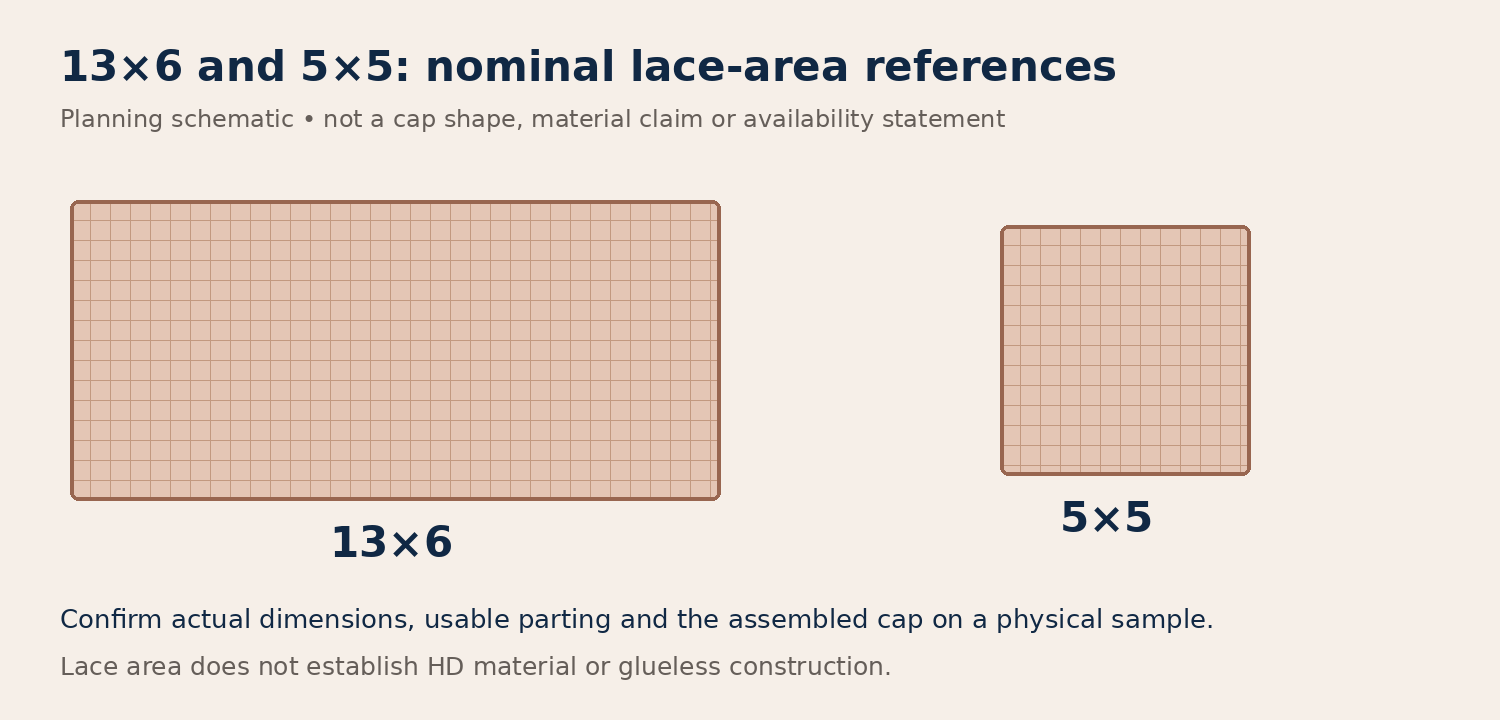
The sizes below are design references to discuss, not a promise that every configuration is available or glueless. Nominal area, usable parting and cap fit must be confirmed on the assembled sample.
| Requested lace area | Buyer decision | Sample confirmation |
|---|---|---|
| 4×4 / 5×5 | Focused closure-area parting | Usable parting, front placement and seam relationship |
| 6×6 / 7×5 | Compare wider or deeper requested closure coverage | Actual dimensions, ventilation and cap compatibility |
| 13×4 / 13×6 | Front coverage with different requested parting depth | Ear-to-ear layout, usable depth, ear tabs and fitted cap |
Avoid Three Specification Shortcuts
Lace dimensions do not establish HD material. HD material does not establish a glueless cap. A product image does not establish band tension or wearer fit. Record all three decisions separately.
Prepare the private label glueless specification checklist, compare HD and transparent lace samples and review the multi-length HD order case.
Related Programs & Buyer Resources
Frequently Asked Questions
Which glueless cap is best for different markets?
Select from actual wearer and fit requirements. No single construction is best for every market; compare complete samples.
Band vs drawstring: what is the difference?
A band supports fit through its position and tension; a drawstring adjusts through a cord route and lock. They can require different attachment and inspection details.
Can cap sizing be customized?
Send required measurements and fit conditions for feasibility and sample review. The approved actual cap establishes the reference.
What should buyers inspect in bulk production?
Compare dimensions, lace placement, seams, band/strap/drawstring/comb identity, attachment and adjustment function against the approved master.
Can a reference cap be reproduced?
Provide a physical cap or inside-cap layout and specify the important features. Feasibility and the accepted sample define the production configuration.
Compare Cap Configurations for Your Product
Send your reference, target market, cap and lace requirements, hair quality priorities, texture, shade, length, density or finished weight, estimated quantities and packaging brief. Use “Not Sure / Please Recommend” for undecided fields. Feasibility, samples and commercial terms are confirmed for the actual project.