
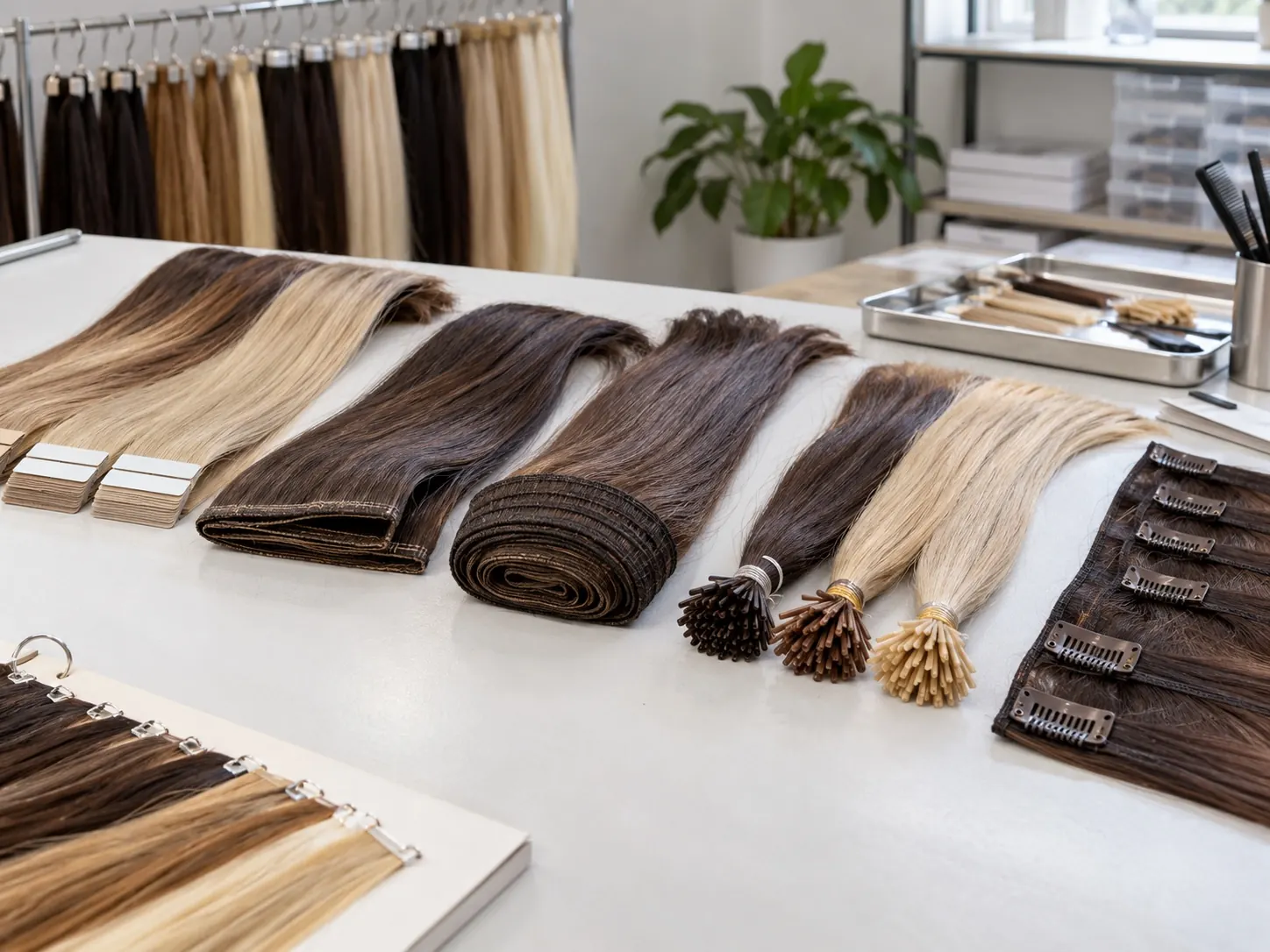
Choosing the Right Hair Extension System
For wholesale buyers, salon distributors and private-label brands, choosing a hair extension method is not only a styling decision. It affects installation time, reusability, customer education, packaging, after-sales risk and the QC points that must be controlled at production.
Vayora recommends defining the buyer profile first: professional salon channel, retail DIY channel, distributor, private-label brand or mixed channel. The correct extension system should match both the end-user experience and the buyer’s service model.
Main Hair Extension Types
Tape-in Hair Extensions
Tape-in extensions use adhesive tabs to attach pre-bonded hair sections close to the scalp. Buyers should compare tape width, base thickness, adhesive strength, residue after removal, tab alignment and whether replacement tape can be used for reapplication.
Genius Weft
Genius weft is selected by buyers who want a thin, flexible weft that can be cut to fit head shape and installation planning. Key sourcing questions include whether the weft can be cut without excessive shedding, whether the edge stays flat and how much return hair is visible.
Machine Weft
Machine weft offers efficient production, stable sizing and broad commercial use. Buyers should check stitching consistency, shedding, fold thickness and weight accuracy.
Hand-Tied Weft
Hand-tied wefts can feel light and flat, but buyers should confirm whether cutting is allowed, how the weft is secured and the appropriate application method for the intended salon channel.
Keratin / U-Tip / I-Tip Systems
Quality depends on hair quality, bond size, keratin consistency, strand loading and clean finishing around the bond area. Buyers should specify desired bond dimensions and installation method before sampling.
Clip-in Hair Extensions
Clip-ins are more retail-friendly because they do not require permanent salon installation. Sourcing should focus on clip comfort, stitching strength, section width, hair distribution, color consistency and packaging.
How Buyers Should Compare Extension Methods
- Installation: salon-only, professional recommended or suitable for at-home use.
- Reusability: whether the system can be removed, retaped or reinstalled.
- Visibility: base thickness, edge profile and concealability.
- Comfort: flexibility, bond size, clip pressure and weight distribution.
- Maintenance: washing restrictions, retaping, re-bonding or repositioning.
- QC risk: adhesive failure, shedding, bond failure, color mismatch or poor stitching.
- Channel fit: salon professional, e-commerce, distributor, private label or mixed wholesale.
A Practical Sourcing Workflow
- Define the target extension method and end-user profile.
- Confirm hair quality tier, color range, length range and weight specification.
- Request representative samples.
- Check attachment construction separately from hair quality.
- Record all sample revisions in writing.
- Approve a final reference sample before bulk production.
- Use the approved specification and sample as the QC reference for repeat orders.
What to Ask a Hair Extension Supplier Before Ordering
A serious sourcing conversation should cover more than price. Ask how the factory controls color batches, hair direction, bleaching quality, weight tolerance, attachment construction and sample-to-bulk consistency.
Vayora helps buyers translate a product idea into a written specification that production and QC teams can follow.
Discuss Your Sourcing Project
Send Vayora your product brief, target colors, lengths, construction and reference samples. We can review the requirements and prepare the next sampling or quotation step.
Request a QuoteFrequently Asked Questions
Which hair extension type is best for wholesale buyers?
There is no single best method. The right choice depends on installation model, price positioning, reuse expectations and customer support.
What should I compare first when evaluating suppliers?
Evaluate hair quality and attachment construction separately.
Should every color and length be sampled?
Not always, but a representative sample set should cover the key risk areas, especially light colors, long lengths and the main attachment construction.
Can one approved sample be used for repeat orders?
Yes, together with a written specification.
Related Guides
Buying Advanced Wefts: Define the Selling Unit and Seam Reference
Before adding an advanced weft direction to an assortment, establish whether the selling unit is a continuous track, a fixed section, linked units or individual strands. The same pack weight does not establish equivalent coverage, construction or service compatibility.
Lock Stitching and Skeleton Stitching Descriptions
Treat these terms as seam descriptions to verify, rather than independent product families. Request close-ups of both faces and the edge, the supplier’s construction explanation and the permitted cutting or end treatment. Record how the accepted seam differs physically from the retained machine, hand-tied or Genius reference. A stitching label alone does not prove durability or innovation.
Define the Pack and Product Version
Keep net hair weight, hardware where present, unit/section count, track width, shade and length on the same SKU record. Retain the accepted sample, packaging version and professional handling instructions. Separate any new base or hardware assembly from ordinary weft reference specifications.
Advanced Weft Buyer Questions
Should Lock Stitching or Skeleton Stitching become a separate product category?
The names alone are insufficient. Verify the actual seam, handling requirements and buyer use. Record a construction variant when appropriate instead of assuming an independent product family.
What should buyers request before adding an advanced weft SKU?
Request an identifiable sample, actual construction views, attachment and hardware details, measurements, hair-weight basis, pack contents, shade reference and professional handling instructions. Confirm availability and commercial terms for that specification.
Specify the Construction Before Requesting a Quote
Send the proposed assortment, construction references, attachment methods, selling units, pack contents, shade/length matrix and estimated quantities. Begin with a verified sample and specification before expanding the range.
Request a QuoteHair Extensions product center · Weft construction review · Compare advanced methods · Pack configuration guide · Sample inspection checklist