
VAYORA HAIR | Wholesale Buyer Knowledge
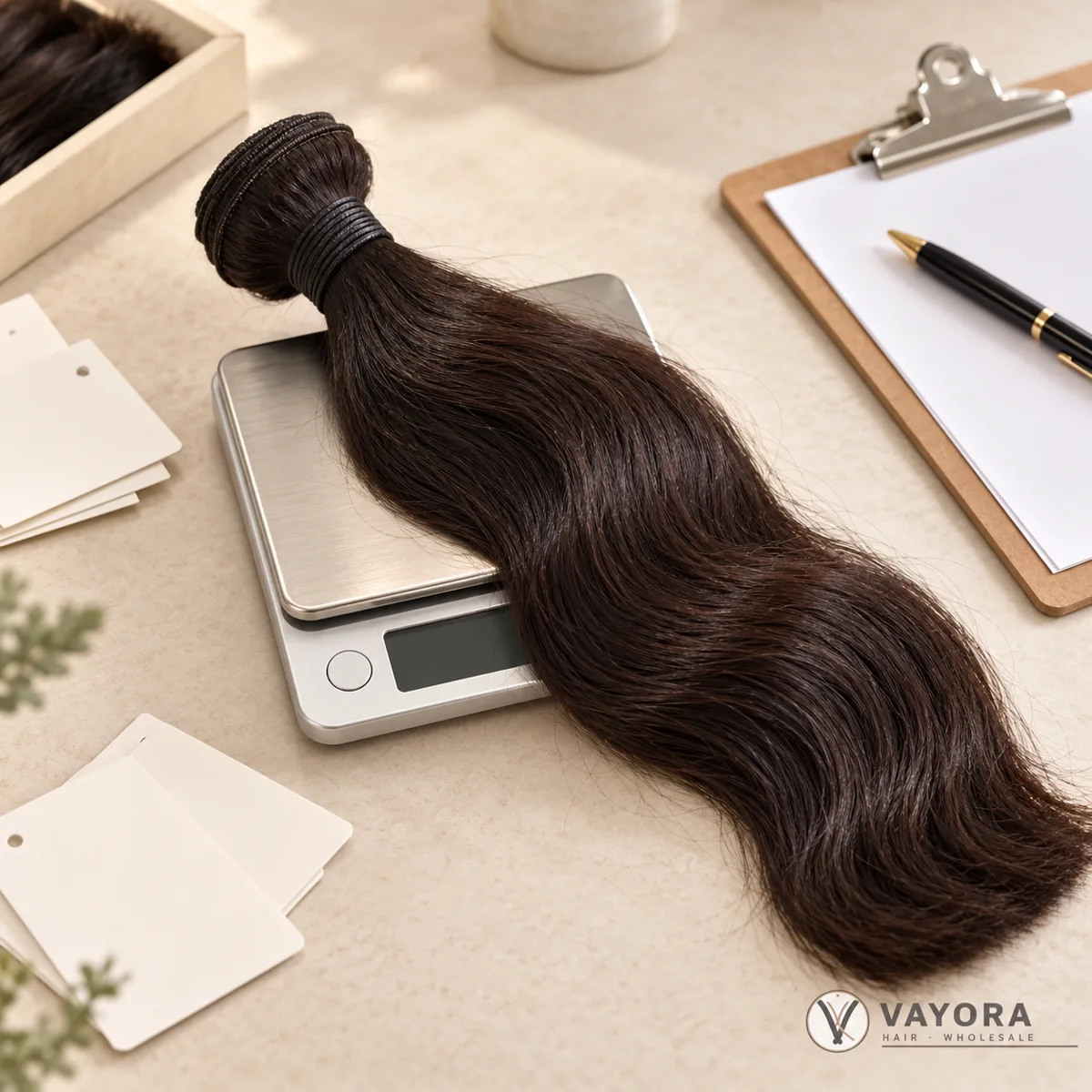
A human hair bundle can meet its stated weight and still leave unanswered questions about processing, retained finish, fiber condition and performance after washing. For wig brands, extension distributors and private-label buyers, weight verification should combine a clear net-weight definition, controlled conditioning, repeatable washing and documented comparison with an approved reference.
Buyer takeaway: Extra measured weight is not proof of extra human hair. Equally, a change in weight after washing is not proof of improper treatment. The useful question is whether the goods meet a mutually agreed specification and maintain acceptable performance after a reproducible test.
What is human hair weight gain treatment?
In sourcing conversations, “weight gain treatment” may refer to a finish or processing step claimed to increase the measured mass of prepared human hair. The phrase is not a single standardized chemical process. A supplier might be describing temporary moisture uptake, deposited conditioning material, a coating, another processing effect or simply a change in weighing conditions. Buyers should not assume that any claimed percentage represents an increase in the amount of hair fiber.
Claims such as “10–15% more weight” need independent verification. Without a documented starting mass, conditioning method, treatment history and post-wash results, the percentage cannot be compared fairly between suppliers.
Why hair weight may change without more hair fibers
Moisture and ambient conditions
Human hair interacts with humidity. Weighing damp samples against samples conditioned in a different environment can create misleading differences. Record temperature, relative humidity and conditioning time; weigh comparison samples only after both have reached a consistent, defined condition.
Surface finishes and deposited material
Conditioners, oils and polymeric finishes can alter feel and may contribute to total mass. Their presence alone does not establish deception or poor quality. For wholesale purchasing, the key issues are disclosure where required by the specification, wash durability, residue, appearance and performance.
Loose fibers, trimming and construction
Weft thread, adhesive, clips, ties, packaging, loose hair and manufacturing waste can change gross or finished-unit weight. Clearly distinguish net hair mass from attachment and packaging mass. For wigs, specify whether the weight is finished-wig weight or a separate hair-weight estimate; these numbers must not be treated as interchangeable.
Use the extension weight and pack-unit guide to define the commercial unit, then record the separate weight and density acceptance requirements.
Does higher weight mean better human hair?
No. Weight is one procurement attribute, not a universal quality grade. For extensions, buyers should also examine length distribution, end fullness, cuticle direction where specified, strand strength, combing behavior, shedding, tangling, color stability and attachment integrity. For wigs, lace, cap construction, hairline, density distribution and stitching also matter.
A heavy-feeling sample may perform well or poorly. A lighter sample may offer better end fullness or more consistent texture. Quality must be evaluated against the particular product specification rather than a single scale reading.
How wholesale buyers can verify human hair weight
Step 1: Freeze the comparison standard
Document supplier, lot ID, SKU, claimed material grade, length, color, texture, finished format, weight definition, packaging configuration and approved sample revision. Retain untreated/initial samples only when their status is genuinely known and documented; do not label an unknown sample “untreated.”
Step 2: Use a calibrated scale and fixed sample handling
Check calibration and resolution appropriate for the sample. Remove only the components excluded by the agreed net-weight definition. Photograph the sample and record any removed clips, ties or backing. Use the same handling procedure for baseline and follow-up readings.
Step 3: Condition samples consistently
Condition test specimens in the same controlled environment and record the time, temperature and relative humidity. Keep weighing containers and handling methods consistent. If conditions cannot be controlled, report the result as a field screening observation—not a definitive determination of abnormal treatment.
Step 4: Perform a controlled wash-and-dry comparison
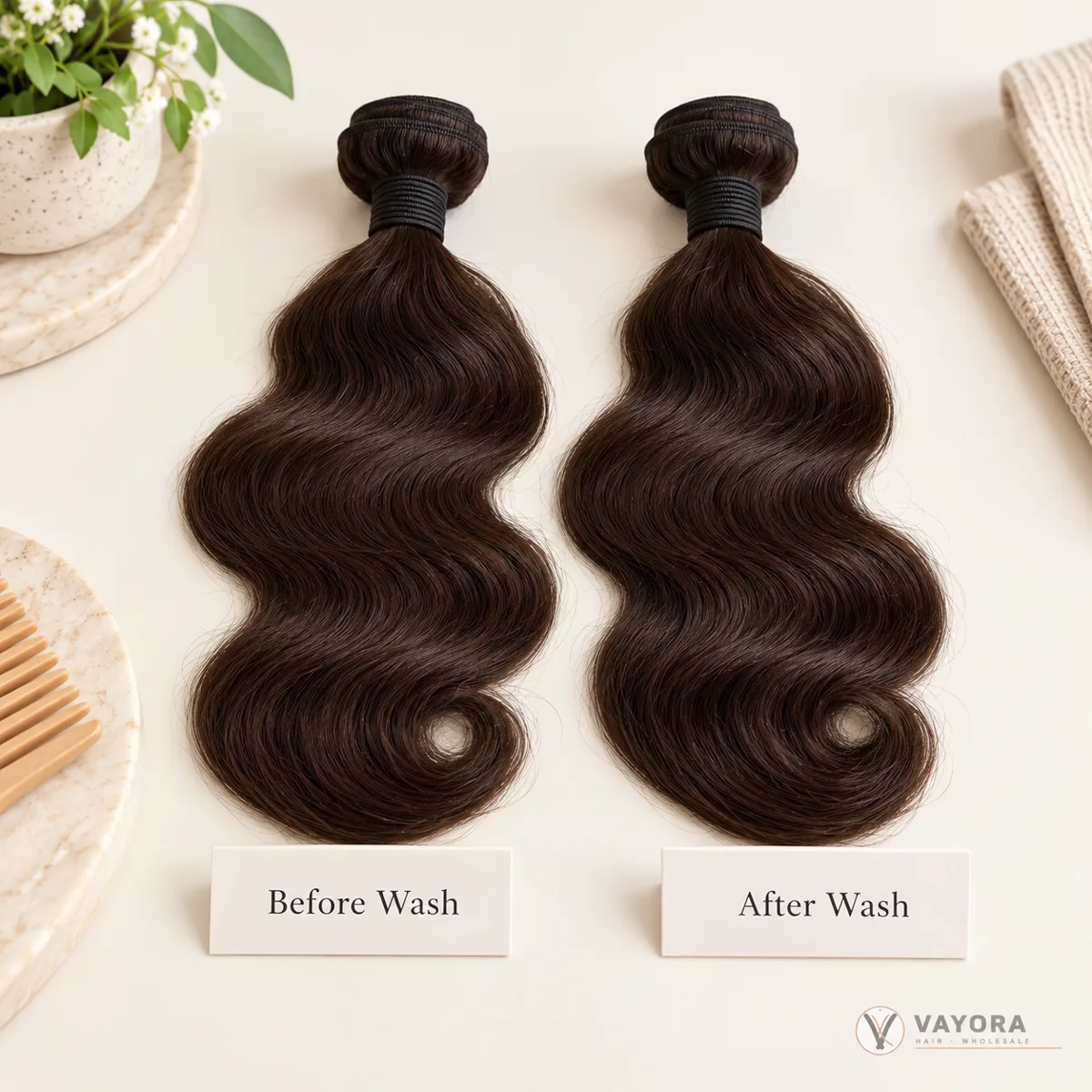
Agree beforehand on the wash product, dilution, water temperature, contact time, rinse method, wash cycles, drying method and reconditioning conditions. Use the same method on an approved control sample and a candidate lot. Photograph and weigh each sample before and after. Do not interpret wet weight as a comparable dry-weight result.
Step 5: Check function, not just grams
Record wet/dry combing, tangling, visible shedding, odor, residue, surface feel, texture retention and end fullness. Where appropriate, have a qualified technician compare color or curl retention and attachment performance against the approved standard. Tests that could damage a sample should be agreed before execution.
Step 6: Make a documented disposition
Compare results with a pre-approved specification and reference, identify any unexplained deviation and request supplier clarification. A single wash-loss figure cannot establish the composition, cause or intent of a treatment. If the outcome matters commercially, commission a suitable independent laboratory assessment.
Weight change calculation: what it does and does not show
Observed change (%) = (conditioned mass after test − conditioned mass before test) ÷ conditioned mass before test × 100.
Example only: a matched sample weighs 100.0 g before an agreed wash cycle and 96.0 g after washing, drying and reconditioning. Its observed mass change is −4.0%. That number does not identify the missing material or prove inappropriate weight gain. Repeatability, a comparison sample and functional checks are essential.
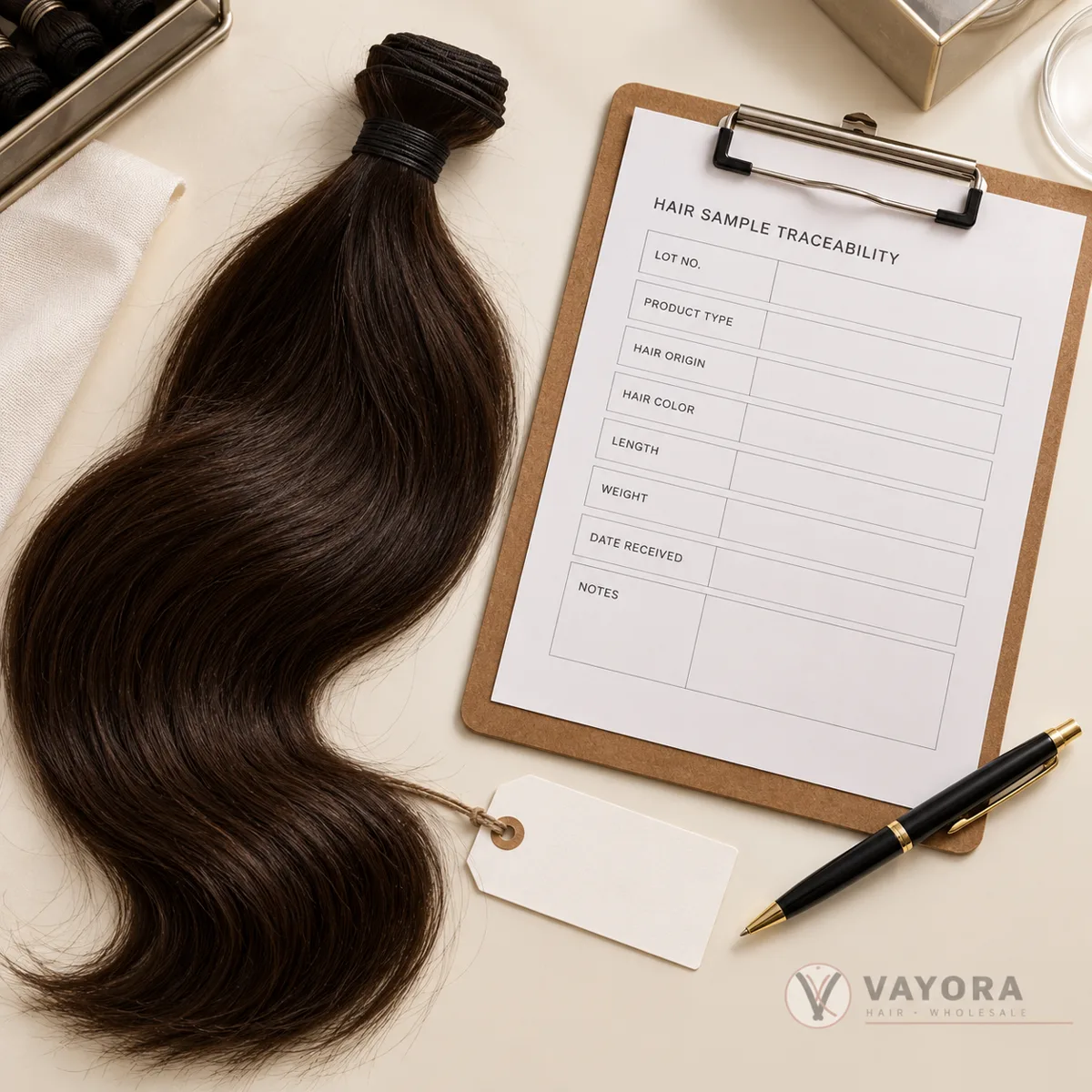
Buyer verification worksheet
Use the fields below as a proposed purchasing checklist. Acceptance limits must be specified for the particular hair type, lot and intended application; VAYORA does not claim a universal pass/fail threshold.
| Field / checkpoint | Evidence or value to record | Decision |
|---|---|---|
| Supplier / lot / SKU / sample revision | Traceable ID and product specification | Confirmed / pending |
| Weight definition | Net hair, finished unit, or packaged gross mass | Confirmed / pending |
| Scale / environment | Scale ID; temperature; RH; conditioning duration | Recorded / pending |
| Baseline mass | Conditioned mass (g), replicate IDs | Recorded / pending |
| Wash protocol | Product, cycle count, rinse, drying and reconditioning | Approved / pending |
| Post-test mass | Conditioned mass (g), replicates and % change | Recorded / pending |
| Handling and appearance | Tangling, shedding, feel, residue, end fullness, photos | Pass / review / fail |
| Supplier processing disclosure | Written response covering relevant finishes / treatments | Received / pending |
| Disposition | Accepted, held for clarification, rejected; reviewer/date | Signed / pending |
Printable lot inspection record: blank fields
This checklist supplements the article table. Use one form per lot / sample condition; do not use it to allege adulteration without supporting evidence.
| Record field | To fill in |
|---|---|
| Inspection date / inspector | ______________________________ |
| Supplier / product / lot | ______________________________ |
| Sample code / revision | ______________________________ |
| Material claim and processing declaration | ______________________________ |
| Length / color / texture | ______________________________ |
| Net weight definition and excluded components | ______________________________ |
| Scale ID / resolution / calibration check | ______________________________ |
| Temperature / RH / conditioning duration | ______________________________ |
| Baseline conditioned mass (g), replicate 1/2/3 | ______________________________ |
| Wash product / dilution / method / cycle count | ______________________________ |
| Drying and reconditioning procedure | ______________________________ |
| Post-test conditioned mass (g), replicate 1/2/3 | ______________________________ |
| Calculated mass change (%) | ______________________________ |
| Control sample ID and mass change (%) | ______________________________ |
| Tangling / shedding / residue / curl retention observations | ______________________________ |
| Photo and video evidence IDs | ______________________________ |
| Agreed acceptance criteria reference | ______________________________ |
| Supplier clarification / corrective action | ______________________________ |
| Disposition and sign-off | ______________________________ |
Questions to ask a human hair supplier before bulk purchasing
- Is the quoted gram weight net hair mass, finished-unit weight or packaged weight?
- What components are included or excluded in that number?
- Which conditioning, coating or finishing steps are used, and what information can be disclosed under our specification?
- Can the same approved hair sample and processing specification be maintained for the next lot?
- Can representative samples be supplied for an agreed wash, dry and reweigh procedure?
- What lot traceability, measurement photos and exception records are available?
- How will material or finishing changes be approved before production?
Where the verification approach differs by product
Raw and virgin hair: define the processing history and permitted finishes with extra care. Do not assume these commercial terms alone guarantee that no finishing has occurred.
Human hair wefts and bundles: separate the hair portion from thread, ties or construction components where the contract calls for net hair weight. Compare end fullness and shedding as well as weight.
Curly and textured extensions: evaluate curl pattern and rebound following the same wash and dry routine; mass alone cannot describe texture stability.
Finished wigs: check the whole system—hair, cap, lace and construction. A finished wig should not be presented as a net hair bundle measurement.
For complete products, combine this mass screen with the finished-wig inspection checklist or the attachment-specific extension QC checklist.
Sample approval and repeat-order controls
The most reliable procurement approach is to approve a physical reference together with written specifications. Capture sample ID, mass definition, photographs, texture and finishing notes, test procedure, agreed limits and sign-off. For repeat orders, compare representative lot samples under the same method and record approved deviations. This reduces disputes whether a difference comes from finishing, natural hair variation, manufacturing or handling.
Frequently asked questions
Can washing reveal weight gain treatment?
Washing may reveal changes in mass, finish or feel, but it cannot by itself identify a treatment or prove misrepresentation. Use controls and, when necessary, specialist analysis.
Is silicone on human hair always a quality problem?
No. Some conditioning finishes are part of normal processing. Evaluate disclosure requirements and performance against the agreed quality brief rather than treating one ingredient category as automatic evidence of a defect.
Is a 100 g human hair bundle guaranteed to contain 100 g of hair fibers?
Not unless the product specification defines 100 g as net hair mass and describes the weighing method. Thread, ties, bonds and other components may be included in some finished-product weights.
What percentage of weight loss after washing is acceptable?
There is no universal percentage suitable for every hair grade, finish and extension system. Establish limits through matched samples, repeat trials and buyer-approved performance requirements.
How can brands compare two supplier quotations fairly?
Normalize material category, net-weight definition, length, end fullness, construction, texture, finishing, sample test results and packaging scope before comparing prices.
Can a buyer request additional laboratory testing?
Yes. Discuss the suspected issue and relevant test with a qualified laboratory; confirm sampling, methods, cost and interpretation before relying on a result.
Source Human Hair With a Clearer Quality Brief
Planning wholesale wigs, bundles or extensions? Send VAYORA HAIR your material expectations, length and weight definitions, texture, target SKU mix, sample requirements and destination market. We can review the sourcing brief and discuss which inspection evidence is feasible for the project. Special tests and acceptance criteria require advance agreement.