
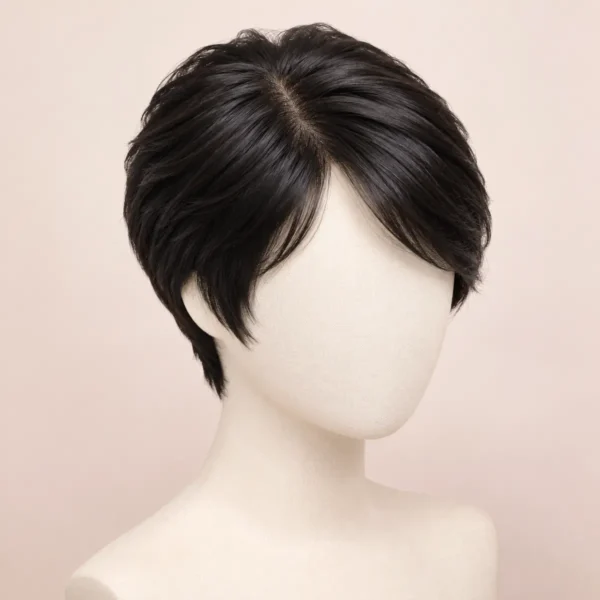
A glueless wig is designed to be worn without glue as the primary means of attachment. That does not mean every glueless unit has the same cap, attachment system or wearing experience. Fit remains individual, and a pre-cut lace edge is not a substitute for an appropriately designed cap.
1. What Makes a Wig Genuinely Glueless?
Ask for an inside-cap photograph and a component list. Depending on the design, securing features may include an adjustable elastic band, nape adjustment, combs or clips, friction-grip areas and shaped ear tabs. Not every customer prefers all these elements: combs may be uncomfortable for some wearers, while tight bands can reduce comfort. Test the planned configuration on representative head sizes and intended user profiles rather than treating “glueless” as one universal standard.
For a wholesale specification, define the required wearing method, supported adjustment range, securing components and instructions. Do not equate “wear-and-go” positioning with a guaranteed 60-second installation. Such timing claims require a controlled test and clear conditions.
2. Cap Size and Fit: Measure More Than Circumference
Head circumference is only one dimension. Record front-to-nape, ear-to-ear over the top, temple placement, nape shape and the comfort of the band or adjustment system. Assess whether the lace front lies flat without excessive tension, whether the ear area sits correctly and whether the wig remains reasonably secure during normal head movement. Fit checks should be voluntary and comfortable; discontinue a trial that causes discomfort.
Buyer verification: Photograph the cap inside out, record actual measurements, note the adjustment positions used and identify the test head size. A small/medium/large size label is insufficient unless its measurements are defined.
3. HD Lace, Transparent Lace and Hairline Finishing Are Separate Decisions
“HD lace” describes a lace material direction, while “transparent lace” describes an appearance or color positioning. Neither guarantees invisible lace on every skin tone or a comfortable fit. Compare lace swatches and finished units under neutral and natural light; inspect edge finish, visibility, tearing, knots and compatibility with the planned cap.
Pre-cut lace, pre-plucked hairline and bleached knots are three distinct specifications. A pre-cut edge may reduce preparation. Pre-plucking changes hairline graduation. Knot bleaching changes knot appearance and needs careful process control. Buyers should request samples demonstrating the requested finish rather than assuming that all premium features are included under “glueless”.
4. Human Hair vs Synthetic: Match Material to the Product Brief
Human hair and synthetic fiber serve different product positions. Human hair may offer styling flexibility subject to the actual processing history and care requirements; it is not automatically safe to bleach, dye or heat-style repeatedly. Synthetic constructions can be suitable for specific styles, colors and budgets, but heat resistance and wear characteristics depend on the fiber specification. Ask for a verifiable material declaration and written handling instructions.
For human hair, distinguish origin, donor collection, processing and finished quality. “Natural color,” “single donor,” “raw” and “cuticle-aligned” are not interchangeable proof of the same property. Avoid adopting unsupported claims in the listing or packaging.
5. The Five Sample Checks That Matter Most to Wholesale Buyers
A. Cap construction and security
Document components, attachment placement, adjustment function, stitch quality and seam comfort. Look for any pressure points or insecure hardware. Compare the cap with the agreed drawings and sample.
B. Lace and hairline presentation
Measure lace coverage, check lace shade, inspect knots, hairline density graduation and parting area. Review a worn or mounted sample under consistent lighting. Keep images of the same camera angles.
C. Length, texture, color and weight
Specify how length is measured for straight and curled hair; compare dry or styled texture under a defined condition. Record finished-unit weight and, if relevant, density separately. A “180% density” label alone cannot replace a measurable fullness or weight reference.
D. Wear and maintenance trial
Use an agreed, non-damaging care and normal-wear protocol to observe comfort, cap movement, lace handling, tangling and visible shedding. Log the number of wears and care actions. Avoid representing a single short test as a durability guarantee.
E. Packaging and repeatability
Confirm SKU labels, length and color markings, care insert, barcodes where needed, and the approved pack-out. Keep an approved golden sample and specification version for comparison with pre-shipment units.
6. How to Approve a Glueless Wig Sample Before Bulk Production
Use a two-stage approval. First, review feasibility and receive an available reference or a specification-based sample. Second, record pass, revision or rejection against each specification. If a component changes—such as band type, lace shade, length measurement, density or cap fit—issue a new version and obtain written approval before treating the sample as the production reference.
For high-priority characteristics, agree the inspection method, acceptance thresholds and sampling plan in the purchase documents. This guide offers a practical checklist; it does not claim that a particular test, tolerance or AQL level has already been completed by VAYORA for every product.
7. Starting a Focused Private Label Collection
A focused collection can be easier to evaluate than a large launch range. Start with an intended wearer, cap and lace platform, then choose a manageable number of textures, lengths and colors. Review whether the same cap assembly can realistically support each finished weight and styling direction.
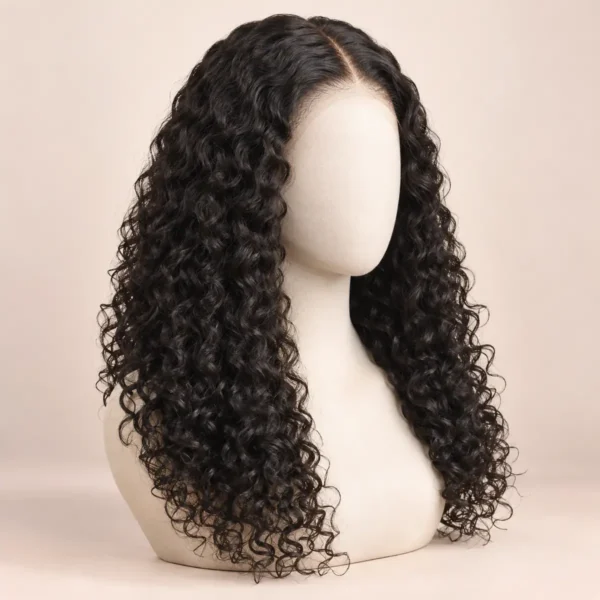
VAYORA currently publicly describes two verified 5×5 glueless product directions: a pixie direction and a Burmese-curly direction. Their respective disclosed length, weight and color parameters appear on the product reference pages linked from the wholesale glueless wigs page. These are product-specific references, not universal specifications for all glueless wigs. Additional lace, cap, color and private-label requirements are reviewed for feasibility and sampling.
8. What to Include in Your Glueless Wig RFQ
Send the intended market and user, lace coverage and shade, cap measurements, attachment features, hair material, texture, length measurement method, finished weight target, color reference, estimated quantity by SKU and packaging brief. If you have a reference wig or technical photos, include inside-cap images as well as front, side and back views.
Ask the supplier to identify what is an approved existing option, what requires a new sample, and what remains pending feasibility. MOQ, quotation, production timing and packaging minimums should be confirmed for the specific approved configuration.
Develop a More Verifiable Glueless Wig Collection
Send VAYORA your target construction, cap size, lace, hair specification, quantity and private-label requirements. We can review the sample route and respond with the information needed for quotation.
Explore Wholesale Glueless Wigs · Plan Samples & MOQ · Request a Quote
Glueless Wig Sample Verification Worksheet (Buyer & Factory)
Record observations and agreed criteria; the table intentionally has no fabricated pass thresholds. Export into a spreadsheet or form if the project needs structured data collection.
| Checkpoint | Evidence / measurement | Approval criteria to agree | Disposition |
|---|---|---|---|
| SKU and reference | Sample ID, version, lot and reference photos | Exact SKU/version match | ☐ Pass ☐ Revise ☐ Reject |
| Cap dimensions | Circumference, front-to-nape, ear-to-ear | Signed target and tolerance | ☐ Pass ☐ Revise ☐ Reject |
| Securing components | Band, combs/clips, nape adjustment, inside photo | Matches approved bill of materials | ☐ Pass ☐ Revise ☐ Reject |
| Comfort and wear | Trial notes for intended wearer and head sizes | Acceptable fit and security without discomfort | ☐ Pass ☐ Revise ☐ Reject |
| Lace material and area | Physical swatch, measured lace size, edge detail | Approved lace reference, color and dimensions | ☐ Pass ☐ Revise ☐ Reject |
| Hairline and knots | Neutral-light close-ups, parting photos | Approved finishing specifications | ☐ Pass ☐ Revise ☐ Reject |
| Length and texture | Measure method, before/after styling images | Approved measurement and style reference | ☐ Pass ☐ Revise ☐ Reject |
| Finished weight / fullness | Measured grams and standardized images | Approved weight / fullness range | ☐ Pass ☐ Revise ☐ Reject |
| Color | Same-light photos against master | Approved shade reference and tolerance | ☐ Pass ☐ Revise ☐ Reject |
| Handling | Documented care/combing and normal-wear observation | Agreed method and pass criteria | ☐ Pass ☐ Revise ☐ Reject |
| Construction | Seams, wefts, transition and attachment points | Approved workmanship standard | ☐ Pass ☐ Revise ☐ Reject |
| Packaging | Label, SKU, artwork, insert, barcode, photo | Approved pack-out and artwork version | ☐ Pass ☐ Revise ☐ Reject |
Sample Approval Record
| Field | Enter |
|---|---|
| Buyer / project ID | ________________ |
| SKU / sample ID / version / date | ________________ |
| Configuration summary | ________________ |
| Reference photos / video filenames | ________________ |
| Outstanding deviation / re-sampling decision | ________________ |
| Approval sign-off + date | ________________ |
| Factory pre-production reference | ________________ |
Collection Planning, Trial Orders & Repeat Orders
Define the Target Customer
Identify the wearer, market and selling channel and the installation support they receive. Use actual customer research rather than assuming one glueless configuration suits everyone.
Set the Target Retail Position
Describe the intended presentation and quality priorities. Pricing remains a project input and quotation decision, not a prescribed market formula.
Build a Length Matrix
Make one row per sellable style/construction/length/color combination. Record the length method and avoid multiplying variants without a sampling plan.
Place a Trial Order
Agree a trial scope using your actual goals, budget and approved specifications. No ideal quantity or fixed MOQ is prescribed.
Review Sell-Through
Review your own sales, returns, fit feedback and support questions. A launch priority is a planning decision, not a prediction of demand.
Plan Repeat Orders
Replenish against the retained masters and current specification. Approve any change to material, shade, cap, finish or packaging before production.
Prepare Your Launch Matrix
Use one row per sellable combination in the First Order SKU Planner. Leave undecided fields open for recommendations; quantity and priority belong to your project.
| Field | Your project input | Reference / open decision |
|---|---|---|
| Style | To be completed by buyer | Record the sample or decision needed |
| Construction / cap size | To be completed by buyer | Record the sample or decision needed |
| Lace / hairline finish | To be completed by buyer | Record the sample or decision needed |
| Length and measurement method | To be completed by buyer | Record the sample or decision needed |
| Texture reference | To be completed by buyer | Record the sample or decision needed |
| Physical shade / placement | To be completed by buyer | Record the sample or decision needed |
| Density appearance / finished weight | To be completed by buyer | Record the sample or decision needed |
| Estimated quantity | To be completed by buyer | Record the sample or decision needed |
| Sample ID / status | To be completed by buyer | Record the sample or decision needed |
| Packaging / artwork version | To be completed by buyer | Record the sample or decision needed |
| Launch priority: Core / Secondary / Later | To be completed by buyer | Record the sample or decision needed |
Preview and download the First Order SKU Planner
Related Technical & Procurement Guides
- Glueless wig manufacturer
- Wig cap construction · Glueless cap component inspection
- Wig lace types
- Glueless wig quality inspection
- Detailed sample approval checklist
- Private label glueless specification
- Private label packaging and specifications
- Samples and MOQ · Quality control
Frequently Asked Questions
Are all glueless wigs ready to wear out of the box?
No. Readiness depends on cap fit, lace trimming or finishing, adjustment requirements and the individual's preferred installation method. Confirm which steps are included in the approved product specification.
Is HD lace required for a glueless wig?
No. Glueless attachment and lace material are separate design decisions. HD lace can be considered where appropriate for a particular construction and buyer brief.
Does pre-cut lace mean the knots are already bleached?
No. Lace cutting, hairline pre-plucking and knot bleaching are separate processes and should be listed individually in the quote and sample specification.
How can a wholesale buyer verify cap fit?
Check actual cap measurements, adjuster position, ear and nape placement, security during normal movement and comfort on representative fit references. Record all findings against the sample ID.
Can human hair glueless wigs always be dyed or heat styled?
No. Possibilities depend on material quality, prior processing, color and manufacturer's product-specific instructions. Test any requested color or styling requirement on a sample before making consumer claims.
What is the minimum order quantity for custom glueless wigs?
MOQ is configuration-dependent. Request a quotation based on the approved lace, cap, hair specifications, color assortment, packaging and total quantity.
Which records matter for repeat orders?
Keep a signed specification, sample ID, dated approved photos, accepted tolerances, artwork files, packaging proof and a record of changes for every SKU.