
2026 US Wig Market Trends: What Wholesale Buyers Should Watch
The U.S. wig market is not moving in one direction. Buyers are seeing several product expectations develop at the same time: easier wear, more natural-looking results, better fit, broader texture and color choices, and stronger expectations around what a premium product should feel like—not only how much hair it contains.

For wholesale buyers, the useful question is not simply, “What is trending?” The better question is: which changes are strong enough to affect construction, assortment, sampling and repeat-production decisions?
The broader category remains substantial. Grand View Research estimates the global wigs and extensions market at USD 16.4 billion in 2026, with North America representing 39.7% of 2025 revenue. Human hair accounted for 52.7% of 2025 market revenue, while the premium tier is forecast to grow at a 10.8% CAGR from 2026 to 2033. These figures do not tell a brand which SKU to launch, but they reinforce the commercial importance of natural appearance, quality, customization and product usability in the higher-value part of the market.
Below are the product shifts VAYORA believes wholesale buyers should translate into concrete development questions.
Convenience Is Becoming Part of Product Design
Convenience is no longer only a marketing message added after the wig is made. It increasingly affects the product itself. Glueless constructions, pre-cut lace, pre-plucked hairlines, pre-bleached knots, adjustable caps and other wear-and-go directions all attempt to reduce the amount of preparation required before the finished look is achieved.
This matters for B2B buyers because “easy to wear” cannot be controlled through one feature. A pre-cut lace edge may reduce one preparation step, but the overall experience still depends on cap fit, security, hairline appearance, lace choice, finished weight and how consistently those details are reproduced.
Reuters reported in September 2026 that glueless and pre-bleached wigs were among top-selling hair-product directions on TikTok in the U.S. market context. That is a useful demand signal, but it should not be interpreted as a guarantee that every glueless product will perform. The product still needs a defined customer, price position and approved construction.
Buyer implication: treat convenience as a product-development brief, not a label. Define which preparation steps the product is intended to reduce, then specify and sample the construction required to deliver that experience.

Natural Appearance Depends on More Than Lace
The premium conversation has often focused on lace type. Lace remains important, but a natural-looking finished result is created by several controls working together: hairline shape, knot appearance, parting, density distribution, texture, color, movement and the relationship between the wig and the wearer’s head shape.
A buyer can select a thin or high-definition lace and still receive a product that looks too heavy at the front, too uniform through the hairline or visually unbalanced through the length. Conversely, a well-planned density distribution and hairline can improve the finished appearance even before styling.
Buyer implication: approve the finished visual result, not only the material name. Sampling should include close views of the hairline and parting as well as the full silhouette.
Glueless Is Expanding From Product Type to Product Platform
Glueless used to function mainly as a construction label. In 2026, it is increasingly useful to think of it as a broader product platform: a family of wigs designed around simpler wear, fit and security without relying on adhesive as the central wearing method.
Within that platform, brands can still create different positions. An everyday glueless wig may prioritize simplicity and accessible specifications. A premium natural-look version may put more emphasis on lace, hairline, parting and lightweight construction. A texture-led version may prioritize blending, movement and a specific customer identity.
Buyer implication: do not build a glueless range by changing only length and color. Give each SKU a role and define how its construction supports that role.
Explore Glueless Product Development
Preparation steps and wearing experience
Hairline, lace, parting and movement
Cap, adjustment and finished weight
A defined customer role
Approve the complete product
Fit and Finished Weight Deserve More Attention
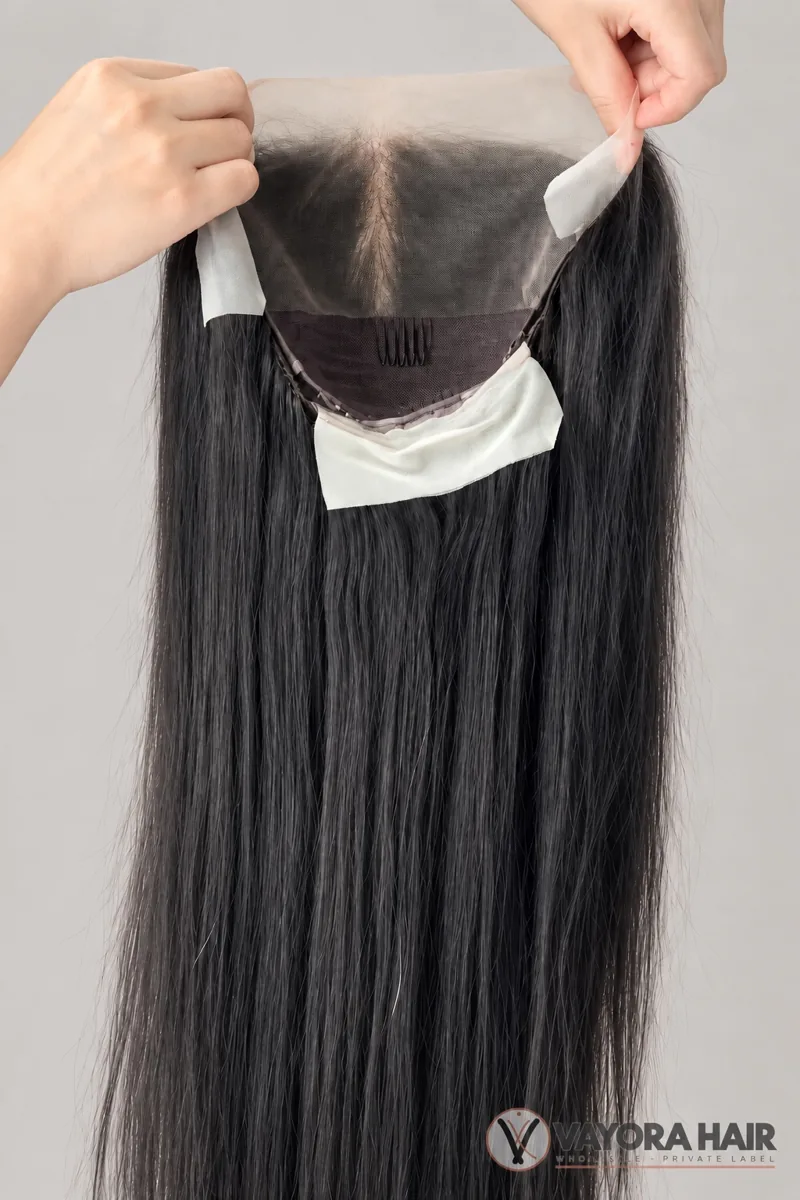
Two products can use similar hair and lace but feel very different in wear because of cap structure, adjustment range and finished weight. These factors become more important as brands promise easier, more secure or more comfortable wear.
Grand View Research’s 2026 market analysis highlights industry innovation around improved fit, lightweight design and easy application. For buyers, that suggests a practical development opportunity: move fit and weight from informal preferences into the written specification and sample-approval process.
Buyer implication: record cap size, adjustment method, attachment components and finished weight or weight tolerance where appropriate. Evaluate how these controls interact with length, density and texture.
Texture and Color Need Clear Customer Roles
More choice is not automatically a stronger assortment. Texture and color expansion can make a collection more relevant, but every additional combination increases sampling, SKU management, inventory and repeat-production complexity.
The stronger approach is to decide what role a texture or color plays. Is it the everyday hero? A natural-texture option? A premium upgrade? A visual social-media SKU? A seasonal test? Once the role is clear, the buyer can decide whether it deserves multiple lengths and densities or should begin as a controlled test.
Buyer implication: expand assortment from customer roles outward, rather than multiplying every specification across every color and texture.
Premium Does Not Always Mean More Hair
Premium wigs are often described through length, density and lace size. Those variables can matter, but a higher-value product can also be defined by more realistic density distribution, better hair movement, cleaner hairline work, more consistent color, a more comfortable cap, stronger finishing and more controlled repeat production.
The premium tier of the broader wigs and extensions market is forecast by Grand View Research to grow faster than the total market from 2026 to 2033. For brands, the opportunity is not simply to add more material. It is to decide which product attributes the target customer is actually willing to pay more for.
Buyer implication: define premium through the complete wearing and ownership experience, then identify which measurable specifications create that experience.
For the product-positioning decision, compare natural density and high density in premium wigs.
What These Trends Mean for a Wholesale Collection
A buyer does not need to react to every trend. A stronger 2026 assortment can be built by choosing a small number of product ideas that solve different customer needs.
- An everyday easy-wear hero product.
- A premium natural-looking upgrade.
- A texture-led option for a clearly defined customer.
- A shorter or lighter everyday option.
- A controlled color or visual accent SKU where the channel supports it.
This is a planning framework, not a universal best-seller list. The final range should reflect the buyer’s channel, target retail price, customer, inventory model and sample results.
Easy-wear hero
Natural-looking upgrade
Defined texture identity
Lighter everyday direction
Controlled accent test
How to Test a Product Direction Before Scaling
Trend research should end in a testable product brief. Define the intended customer and wearing experience, choose the minimum number of SKUs needed to test the idea, write the specifications, sample the physical products and record the approved reference before expanding the matrix.
The goal is not to predict the entire market perfectly. The goal is to reduce unnecessary assortment complexity while creating a clearer path from market signal to repeatable product.
Turn Market Direction Into a Testable Collection
Tell VAYORA where you sell, who the collection is for and what position you want to build. Start with a focused brief, then move into specification and sampling.
Sources & Editorial Context
Market evidence checked on 15 October 2026. Market figures cover wigs and extensions together; global and North American figures are context, not a U.S. wig-only market estimate. Product implications are VAYORA editorial interpretation, not sales forecasts.