
For a wholesale hair program, “single drawn” and “double drawn” describe how much shorter hair remains
For commercial specifications, available extension systems, sample approval and private label development, review VAYORA’s Wholesale Double Drawn Human Hair Extensions page.Source Double Drawn Extensions for Your Product Range
The useful buying decision is to define the finished silhouette your customers expect, then approve a measurable sample at each length and texture. This guide applies to human hair bundles and extensions; the same questions can inform wig material selection, while cap construction and ventilation add separate variables.
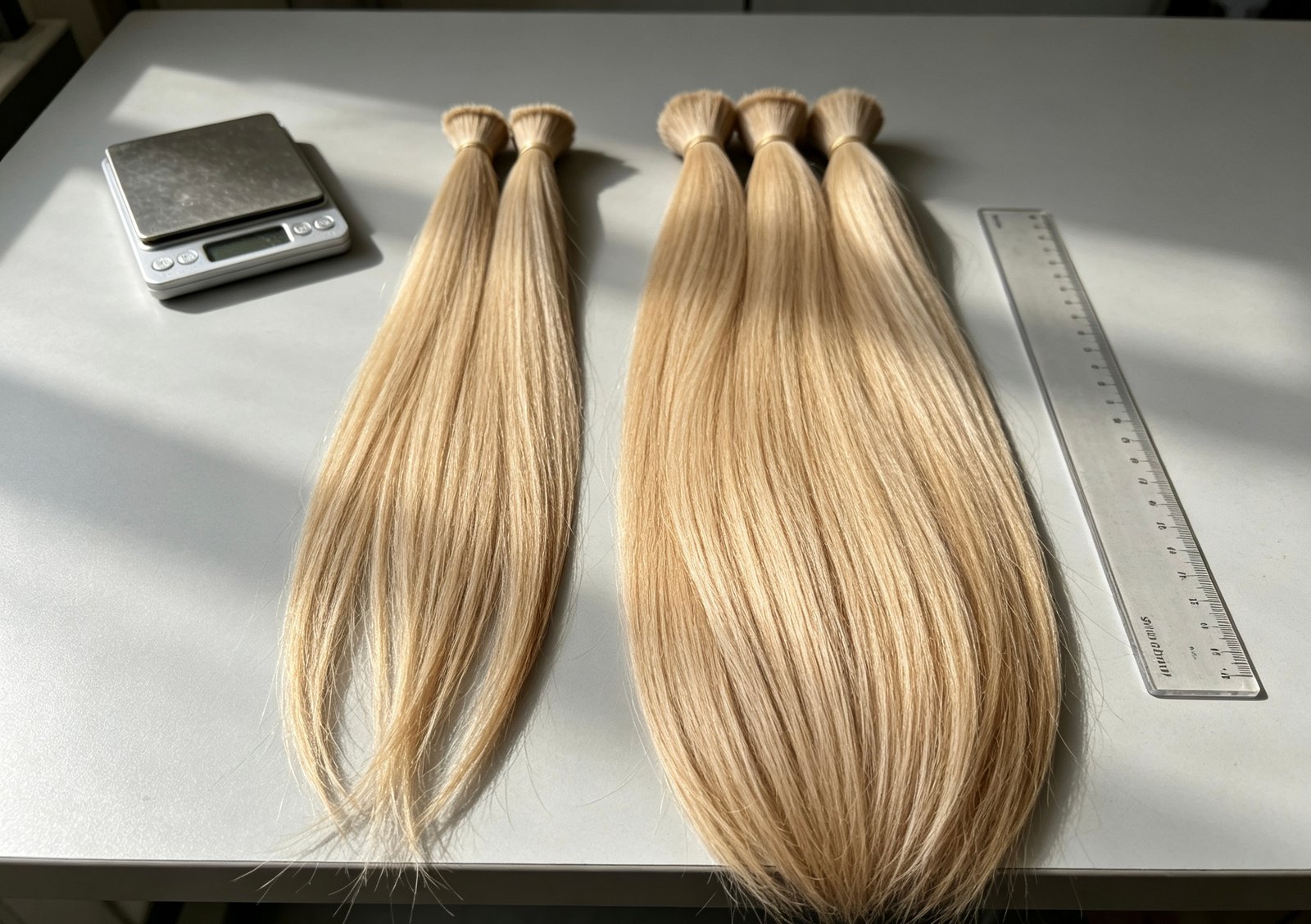
What do single drawn and double drawn mean?
Single drawn hair typically includes a broader mix of strand lengths. It can taper more visibly toward the ends and create a softer, natural-looking finish. Double drawn hair is sorted more heavily to reduce shorter strands, so more of the mass reaches toward the stated length and the ends look fuller. The labels describe sorting and presentation, not cuticle alignment, raw/virgin processing history, or a promise that every strand is identical in length.
A “double drawn” claim alone does not specify the proportion of full-length hair. Suppliers may use different sorting thresholds. Agree on the finished appearance, weight, length measurement method and tolerance with an approved reference sample.
Single drawn vs double drawn at a glance
| Buyer factor | Single drawn | Double drawn |
|---|---|---|
| Length mix | More short strands may remain | Short strands are reduced by additional sorting |
| End silhouette | Typically more tapered | Typically fuller and more uniform |
| Weight distribution | More weight can sit above the ends | More mass can extend toward the ends |
| Material cost | Often lower for a comparable specification | Often higher because of sorting and yield |
| Best fit | Natural taper or layered styling | Blunt, dense-looking ends or a fuller finish |
These are typical comparisons, not guaranteed results. Strand diameter, curl pattern, processing, weft construction, finished weight and trimming can all change how a product looks.
Why weight and length must be specified together
Two bundles can have the same total weight and advertised length yet look different at the bottom. A fuller-end bundle uses more long strands within that weight, while a tapered bundle carries more of its mass higher up. Adding weight to a single drawn product may increase overall volume without reproducing a double drawn end shape.
Compare like with like: the same stated length, net hair weight, texture, color, base or weft construction, and dry styling condition. Record whether length is measured straight, stretched or along a wave. For curly textures, measure under a stated method and compare both the relaxed and extended appearance.
How wholesale buyers can approve end fullness
- Define the intended style. State whether the line needs natural taper, blended layers or a blunt, full-end appearance.
- Compare matched samples. Use the same length, texture, color, weight and base type. Ask for front, side and end photos under consistent lighting, plus physical samples where possible.
- Measure the finished piece. Document net hair weight, length method and the visual fullness at the lower section. If a numeric short-hair allowance is essential, agree on the measurement method and acceptance tolerance in writing.
- Wash and comb consistently. Check how the ends look after normal handling, wash and air drying; note shedding, tangling and excessive short-hair release separately.
- Approve across SKUs. A 14-inch straight sample does not automatically approve a 24-inch wave. Check representative lengths, textures and colors before bulk production.
- Retain a master sample. Use the approved physical sample and written specification for bulk comparison and repeat orders.
Use the sample approval process to record revisions before scaling. For hair-origin and cuticle terms, see our raw, virgin and Remy hair comparison; those terms answer a different sourcing question.
Which option fits an extension collection?
Single drawn can suit an assortment designed for a softly layered result or a more accessible price position. Double drawn may better suit clients expecting visually dense ends, a blunt cut or stronger fullness at longer lengths. The right choice depends on the complete SKU, including attachment method and the customer’s installation and styling plans.
Start with the wholesale hair extensions range, then compare attachment methods and their inspection points. Drawn level is only one dimension of the specification; color matching and approved shade references are covered in the human hair color chart guide.
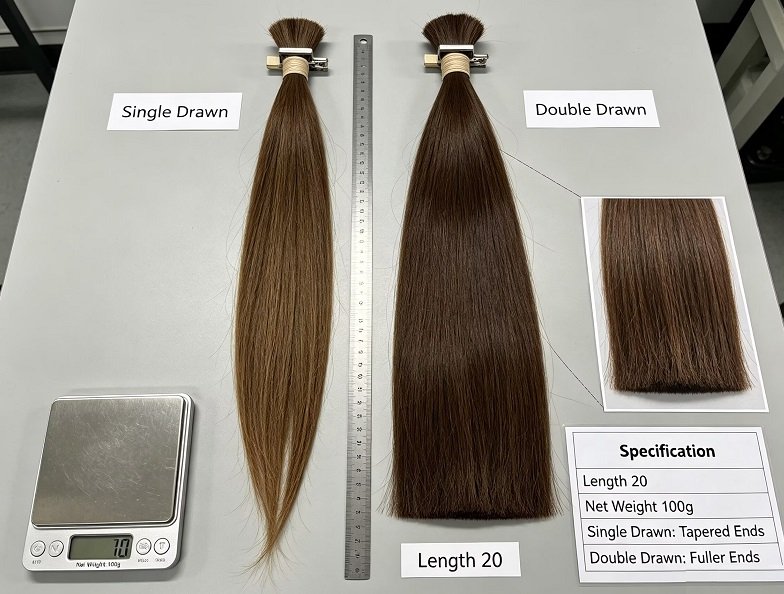
Matched sample comparison: a record buyers can repeat
A label or a styled photograph does not establish the end profile of a production SKU. Compare a single drawn and a double drawn sample only after matching the product type, base or weft construction, stated length, net hair weight, texture, color and finishing state. Give each unit a unique sample ID. If one sample differs in any of these variables, note the difference and avoid treating the visual result as proof of the drawn level alone.
- Record the starting condition. Note whether the hair is unwashed, washed and air-dried, stretched, or heat styled. Use the same condition for both units and photograph them against the same background, scale and lighting.
- Measure length and weight consistently. Specify the start and end points for length, whether curls are stretched, the scale used and whether packaging or clips are excluded from net hair weight. Record the actual readings rather than copying the advertised specification.
- Show the silhouette. Photograph the front, side and bottom with the hair hanging freely. Record how the lower section tapers or fills out, and whether a planned trim changes the comparison. Do not convert a visual impression into a “full-length hair percentage” without an agreed sampling method.
- Repeat after care. If the buyer’s intended use includes washing, repeat the photographs after the same wash and drying procedure. Record shedding or tangling separately from end fullness.
- Approve the reference. Mark pass, revise or reject against the buyer’s intended end shape and agreed tolerances. Retain the dated physical unit and its specification for production checks.
| Record field | Single drawn sample | Double drawn sample |
|---|---|---|
| Sample ID / revision / date | Enter actual ID | Enter actual ID |
| SKU, construction, color, texture | Enter matched specification | Enter matched specification |
| Stated and measured length; method | Enter reading and method | Enter reading and method |
| Net hair weight; scale | Enter reading and scale | Enter reading and scale |
| Condition and photo IDs | Enter wash/style state and files | Enter wash/style state and files |
| End shape and approval result | Describe; pass/revise/reject | Describe; pass/revise/reject |
This is a blank buyer approval record, not VAYORA test data or a specification for a stocked SKU. For a versioned revision log and a retained production reference, use the wig sample approval checklist. The hair extension QC guide covers attachment and durability checks that the drawn label does not establish.
Questions to send with a quote request
- Which lengths, textures, colors and extension methods are required?
- What finished net hair weight and end silhouette should each SKU have?
- How should length and any short-hair allowance be measured?
- Will the product be trimmed, colored or heat styled after purchase?
- Which physical samples should serve as the approval standard?
Share the target market, reference photos and SKU list through Request a Quote. VAYORA can review the proposed specification and confirm available options, sample route, pricing and MOQ case by case.
FAQ
Is double drawn always better quality?
No. It usually indicates a fuller end profile from additional sorting. Hair condition, strand alignment, processing and construction still need separate evaluation.
Does double drawn mean every strand reaches the stated length?
No. Shorter strands can remain. Ask for a sample and an agreed acceptance method instead of assuming a universal percentage.
Can I compare single and double drawn using photos alone?
Photos help screen the silhouette but cannot confirm weight, handling or repeatability. Matched physical samples and written measurements give a stronger approval basis.
Keep the Approved Fullness Reference Across Orders
Record the accepted hair distribution alongside measurement conditions and specification versions. A grade name does not replace the retained sample.