
Human hair buyers often receive quotations using labels such as 8A, 9A, 10A, 12A or other grade names.
These labels can make sourcing look simple: a higher number appears to mean higher quality.
Supplier-defined labels
For wholesale purchasing, however, that assumption can be misleading.
There is no single universal grading system used consistently by every human hair supplier. A grade may be useful inside one supplier's own product system, but the same label can describe a different material, processing history or finished specification elsewhere.
For that reason, professional buyers should compare the characteristics behind the grade rather than treating the grade name itself as the specification.
This guide explains what to compare when evaluating human hair for wigs, extensions and private label production.
What Does a Human Hair Grade Actually Mean?
A hair grade is usually a supplier-defined way to separate different material or product levels inside that supplier's own range.
The grade may reflect one or more factors such as material selection, processing history, strand condition, usable length, fullness, color capability, texture performance or internal sourcing cost. The problem is that the exact formula behind the grade is rarely identical across companies.
One supplier may use 10A for a premium product line, while another may use 10A for a mid-range line. The number alone does not tell the buyer whether the two products are equivalent.
Why 8A, 10A and 12A Are Not Universal Standards
Terms such as 8A, 10A and 12A are widely recognized in the market, but they should not be treated like internationally standardized technical grades.
A buyer should therefore avoid assumptions such as:
- 12A is always better than 10A across every supplier.
- Two 10A quotations describe the same material.
- A higher grade guarantees a specific lifespan.
- A grade number proves a specific origin or processing history.
- A grade name guarantees identical color, texture or fullness in every batch.
A more reliable approach is to ask each supplier what measurable or observable product characteristics sit behind the label.
Grades Can Still Be Useful — Within the Same Supplier
A supplier's internal grade system can still be useful when it is applied consistently within that supplier's own product range.
For example, a buyer may compare two sample levels from the same manufacturer and decide which specification fits the target market and price position.
In that case, the grade functions as an internal product reference.
The mistake happens when the buyer assumes that the same label has exactly the same meaning at another factory.
What Wholesale Buyers Should Compare Instead
Instead of asking only “What grade is this hair?”, buyers should compare the complete material and finished-product specification.
| Comparison Area | What the Buyer Should Ask |
|---|---|
| Hair material | What material specification is being supplied, and is it suitable for the final product? |
| Processing history | Has the hair been colored, bleached, textured or otherwise chemically processed? |
| Cuticle / strand condition | What is the observable strand condition and how does it behave in the finished product? |
| Length | How is length measured, and does the finished product meet the confirmed specification? |
| Fullness | How full is the hair through the mid-lengths and ends for the intended product? |
| Color capability | Can the material achieve the required shade while meeting the agreed finished-product standard? |
| Texture capability | Can the requested texture be produced and repeated consistently? |
| Construction compatibility | Is the material suitable for the required wig, weft, tape, keratin-tip or other construction? |
| Sample accuracy | Does the sample match the buyer's confirmed specification? |
| Bulk consistency | Can the approved specification be reproduced at bulk scale and in repeat orders? |
1. Hair Material and Processing History
The first comparison should be the material itself and what has happened to it before the finished product is made.
Processing can affect color response, texture, strand condition and suitability for further customization.
Two products with the same grade name may have very different processing histories.
For B2B sourcing, the buyer should ask whether the material is appropriate for the final specification rather than assuming that a higher grade number automatically means better performance.
2. Length and Fullness
Length is not only a number on a price list.
Buyers should confirm how the supplier measures the product and what level of fullness is expected through the length.
The appropriate fullness depends on the product category and the commercial specification.
A wig, a machine weft, a keratin-tip extension and a clip-in set should not be judged using one identical visual rule.
The correct comparison is whether each product matches the confirmed specification for that construction.
3. Color Capability
Color capability is often more commercially useful than a grade label.
A buyer sourcing natural shades may need a different material specification from a buyer sourcing light blonde, highlighted or multi-tone products.
The relevant question is not simply whether the supplier says the material is 10A or 12A.
The better question is whether the material can reach the required color while maintaining the agreed finished-product standard.
For demanding colors, sample approval becomes especially important.
4. Texture Capability and Repeatability
Texture can be natural, processed or created as part of production, depending on the product and specification.
Buyers should evaluate the actual finished texture rather than relying on the grade label.
For repeat business, the important issue is whether the supplier can reproduce the approved texture closely enough for the buyer's commercial requirements.
This should be evaluated through samples and repeat-order control.
5. Product Construction Changes the Quality Evaluation
Good hair material does not automatically guarantee a good finished wig or extension.
The final result also depends on construction.
| Product Type | Construction Factors to Evaluate |
|---|---|
| Lace wigs | lace/cap construction, ventilation, density, hairline, parting, finished styling |
| Wefts | weft construction, width, weight basis, seam quality, finished consistency |
| Keratin-tip extensions | strand specification, tip construction, attachment consistency, quantity basis |
| Tape / PU extensions | PU/tape construction, attachment consistency, finished weight/quantity basis |
| Clip-in / Halo / Ponytail | set construction, attachment, finished weight, assembly, overall appearance |
This is why material quality and manufacturing quality should be evaluated together rather than as separate subjects.
6. Sample Quality Matters More Than the Grade Name
For a new supplier or new specification, the sample gives the buyer something concrete to evaluate.
A buyer can compare two samples labeled with different grades, but the decision should be based on the actual commercial requirements of the product.
The higher-priced or higher-numbered sample is not automatically the correct choice.
The correct sample is the one that best fits the target market, target price, color, texture, construction and repeatability requirements.
How to Compare Two Supplier Samples
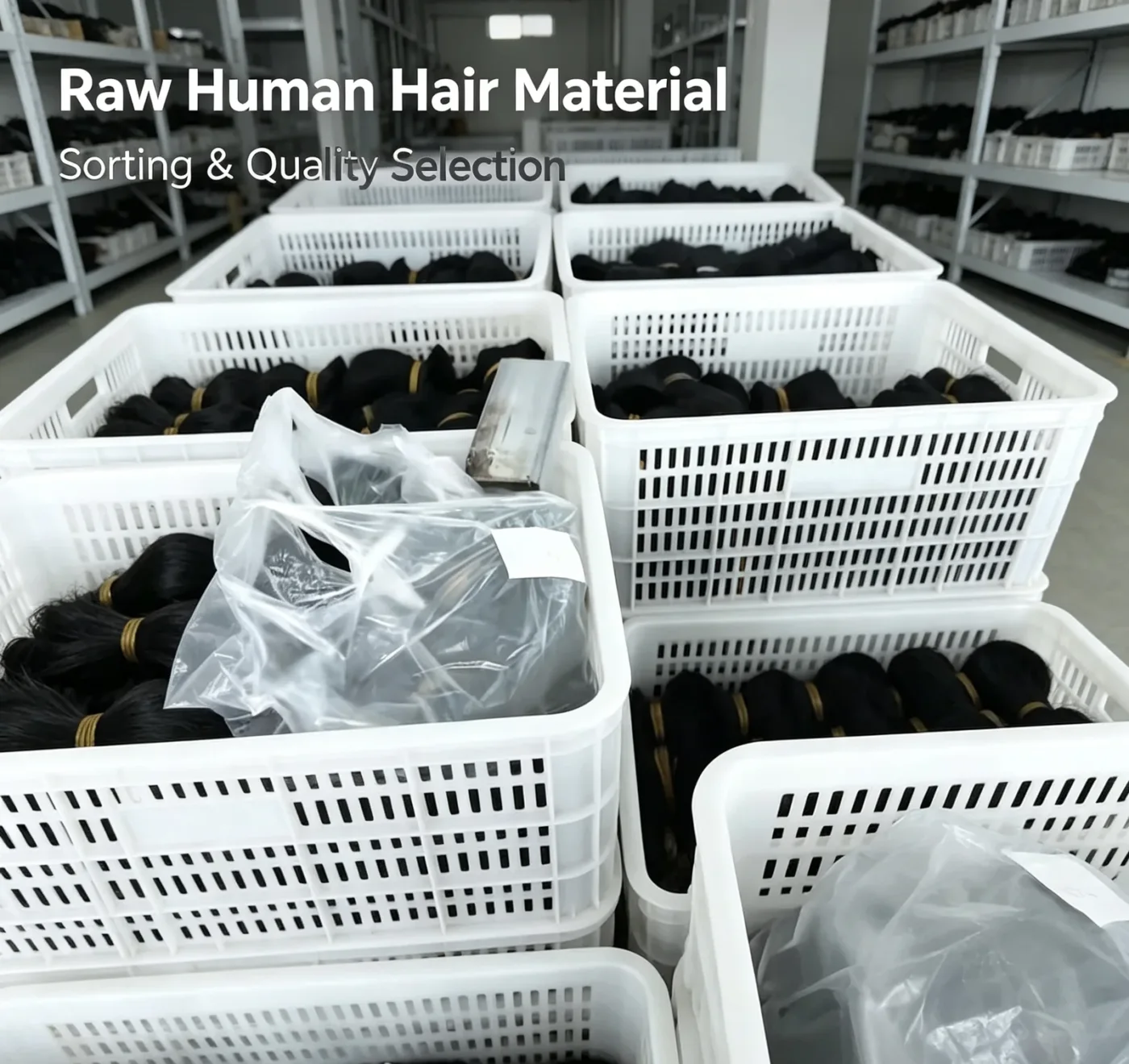
When comparing samples from different suppliers, use the same evaluation framework for both. Do not compare only touch, shine or first impression.
| Evaluation Item | Buyer Check |
|---|---|
| Specification match | Does the sample match the requested product type, length, color, texture, density/construction and packaging requirement? |
| Material appearance | Does the material look appropriate for the target market and product positioning? |
| Length / fullness | Does the finished product meet the confirmed measurement and visual specification? |
| Color | Is the shade within the approved target range? |
| Texture | Is the texture suitable and consistent for the intended SKU? |
| Construction | Is the wig/extension construction correct and commercially usable? |
| Finished consistency | Are different pieces or units reasonably consistent with one another? |
| Reproducibility | Can the supplier explain how the approved sample will be used as a bulk-production reference? |
Avoid Comparing Samples With Different Specifications
A common sourcing mistake is comparing two samples that are not actually the same specification.
For example, one supplier may quote a different density, lace type, weight basis, construction, hair length or color process.
The lower price may simply reflect a different product.
Before deciding which supplier offers better value, make sure both suppliers are quoting and sampling against the same technical requirement.
Price Should Be Compared With Specification, Not Grade Alone
A higher grade label usually comes with a higher price, but the price difference only matters if the underlying specification also provides value for the buyer's market.
A business selling an entry-level collection may not need the same material specification as a premium private label brand.
Likewise, a premium brand may decide that better color capability, fuller ends, more controlled consistency or stronger repeatability justifies a higher sourcing cost.
The sourcing goal is not to buy the highest label. It is to buy the correct specification for the business model.
What About “Single Donor”, “Remy” and Other Quality Terms?
Human hair sourcing includes many additional terms beyond numeric grades.
These terms may describe material origin, alignment, processing or marketing position, but their exact use can also vary between suppliers.
Buyers should use the same principle: ask what the term means for the actual product being quoted, what can be verified through the sample, and how the specification will be controlled in bulk production.
Do not use a marketing term as a substitute for a complete purchase specification.
What Buyers Should Put in the Purchase Specification
A strong purchase specification reduces dependence on vague grade labels.
- product type / construction
- hair material specification
- length
- weight or quantity basis where applicable
- density where applicable
- lace / cap specification where applicable
- color
- texture
- attachment / tip / tape / weft construction where applicable
- branding and packaging
- approved sample or reference
- agreed bulk-production requirements The exact fields should depend on the product. Do not copy one specification template blindly across every wig and extension category.
The Real Quality Question: Can the Specification Be Repeated?
For wholesale buyers, quality is not only about receiving one attractive sample.
The larger commercial question is whether the supplier can reproduce the agreed product with acceptable consistency in bulk and in future repeat orders.
That requires a link between the confirmed specification, approved sample, manufacturing process, quality control and final packing.
A grade label cannot replace that process.
A Better Way to Ask About Human Hair Quality
Instead of asking only:
“What grade is your hair?”
Ask:
- What material specification is this?
- What processing has it undergone?
- What color and texture can it support?
- How is length / weight / quantity defined for this product?
- What construction is being quoted?
- Can I evaluate a sample before bulk production?
- How will the approved sample be translated into the bulk order?
- How are repeat orders controlled?
These questions give a buyer much more useful information than a grade number alone.
Work With VAYORA on a Measurable Product Specification
VAYORA works with wholesale buyers, brands, distributors and salon businesses on human hair wigs and hair extension projects.
Rather than relying only on a grade label, buyers can provide the target product type, length, color, texture, construction, target market, packaging requirement and expected order requirement.
Our team can review the specification and discuss sampling, manufacturing and bulk-production requirements.
FAQ
What do 8A, 10A and 12A mean in human hair?
They are usually supplier-defined grade labels rather than universal industry standards. Their exact meaning can vary between suppliers, so buyers should ask what material and product characteristics each grade represents.
Is 12A hair always better than 10A hair?
Not necessarily across different suppliers. A higher grade may represent a higher internal product level within one supplier, but the buyer should compare the actual material, processing, color capability, construction and sample quality.
How can I compare hair quality between suppliers?
Give suppliers the same product specification and compare actual samples using the same criteria, including material, length, fullness, color, texture, construction and the supplier's ability to reproduce the approved specification in bulk.
Should I choose the highest hair grade available?
Not automatically. The best sourcing choice depends on the target market, product position, required processing, construction, consistency and price level.
Can a hair grade guarantee how long the product will last?
A grade label alone should not be treated as a lifespan guarantee. Product performance can depend on material, processing, construction, use and maintenance, so buyers should focus on the agreed specification and sample evaluation.